Ch. 4 - Isomers: The Arrangement of Atoms in Space
Bruice - Organic Chemistry 8th Edition
Bruice8th EditionOrganic ChemistryISBN: 9780135213711Not the one you use?Change textbook
Chapter 5, Problem 36

Naproxen, a nonsteroidal anti-inflammatory drug that is the active ingredient in Aleve (p. 115), has a specific rotation of +66. One commercial preparation results in a mixture with a 97% enantiomeric excess.
a. Does naproxen have the R or the S configuration?
b. What percent of each enantiomer is obtained from the commercial preparation?

Verified step by step guidance
1
Determine the configuration of naproxen by analyzing its specific rotation. A positive specific rotation (+66) indicates that the compound is dextrorotatory. Since the R/S configuration is determined experimentally and naproxen is known to have the S configuration, we conclude that naproxen is the S enantiomer.
Understand the concept of enantiomeric excess (ee). Enantiomeric excess is defined as the difference in the percentage of the two enantiomers in a mixture. It is calculated using the formula: ee = (%majorenantiomer%minorenantiomer). In this case, the enantiomeric excess is given as 97%.
Relate the enantiomeric excess to the percentages of the two enantiomers. The formula for enantiomeric excess can also be expressed as: ee = (%majorenantiomer%minorenantiomer) = (%majorenantiomer − (100 − %majorenantiomer)). Simplify this to find the percentage of the major enantiomer: %majorenantiomer = (ee + 100)/2.
Calculate the percentage of the major enantiomer (S-naproxen) using the formula derived in the previous step. Substitute the given enantiomeric excess (97%) into the formula: %majorenantiomer = (97 + 100)/2. This will give the percentage of the S enantiomer in the mixture.
Determine the percentage of the minor enantiomer (R-naproxen). Since the total percentage of both enantiomers must equal 100%, subtract the percentage of the major enantiomer from 100%: %minorenantiomer = 100 − %majorenantiomer. This will give the percentage of the R enantiomer in the mixture.

Verified video answer for a similar problem:

This video solution was recommended by our tutors as helpful for the problem above.
Video duration:
3m
Was this helpful?

Key Concepts

Here are the essential concepts you must grasp in order to answer the question correctly.

Chirality and Enantiomers

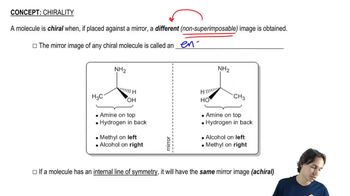
Chirality refers to the property of a molecule that makes it non-superimposable on its mirror image, leading to the existence of two enantiomers, which are stereoisomers that are mirror images of each other. In organic chemistry, enantiomers can have different biological activities, making their identification crucial in drug development.
Recommended video:
Guided course
05:10
What is chirality?

Specific Rotation

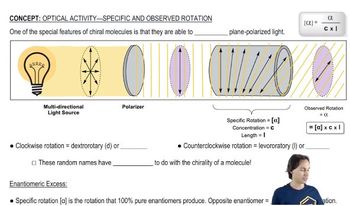
Specific rotation is a measure of how much a chiral compound rotates plane-polarized light, expressed in degrees. It is an intrinsic property of chiral substances and is used to determine the purity and configuration of enantiomers. A positive specific rotation indicates the presence of the R enantiomer, while a negative value suggests the S enantiomer.
Recommended video:
Guided course
05:43
Specific rotation vs. observed rotation.

Enantiomeric Excess (ee)

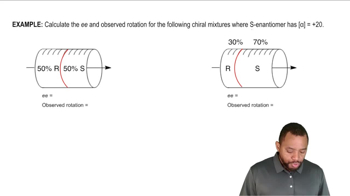
Enantiomeric excess is a measure of the purity of an enantiomer in a mixture, calculated as the absolute difference between the mole fractions of the two enantiomers. It is expressed as a percentage and indicates the predominance of one enantiomer over the other. A 97% enantiomeric excess means that one enantiomer is significantly more abundant than the other, which is critical for understanding the drug's efficacy and safety.
Recommended video:
Guided course
03:59
Calculating Enantiomeric Excess and Observed Rotation
Related Practice
Textbook Question

The reaction of (R)-1-iodo-2-methylbutane with hydroxide ion forms an alcohol without breaking any bonds to the asymmetric center. The alcohol rotates the plane of polarization of plane-polarized light counterclockwise. What is the configuration of (+)-2-methyl-1-butanol?

Textbook Question

The following compound has only one asymmetric center. Why then does it have four stereoisomers?

1
views
Textbook Question

a. Stereoisomers with two asymmetric centers are called ___ if the configuration of both asymmetric centers in one stereoisomer is the opposite of the configuration of the symmetric centers in the other stereoisomer.

b. Stereoisomers with two asymmetric centers are called ___ if the configuration of both asymmetric centers in one stereoisomer is the same as the configuration of the asymmetric centers in the other stereoisomer.

c. Stereoisomers with two asymmetric centers are called ___ if one of the asymmetric centers has the same configuration in both stereoisomers and the other asymmetric center has the opposite configuration in the two stereoisomers.

5
views
Textbook Question

(+)-Mandelic acid has a specific rotation of +158. What would be the observed specific rotation of each of the following mixtures?

c. 75% (-)-mandelic acid and 25% (+)-mandelic acid

1
views
Textbook Question

The stereoisomer of cholesterol found in nature is shown here.

a. How many asymmetric centers does cholesterol have?

b. What is the maximum number of stereoisomers that cholesterol can have?

1
views
Textbook Question

The observed rotation of 2.0 g of a compound in 50 mL of solution in a polarimeter tube 20 cm long is +138°. What is the specific rotation of the compound?