Ch. 4 - Isomers: The Arrangement of Atoms in Space
Bruice - Organic Chemistry 8th Edition
Bruice8th EditionOrganic ChemistryISBN: 9780135213711Not the one you use?Change textbook
Chapter 5, Problem 35c

(+)-Mandelic acid has a specific rotation of +158. What would be the observed specific rotation of each of the following mixtures?
c. 75% (-)-mandelic acid and 25% (+)-mandelic acid

Verified step by step guidance
1
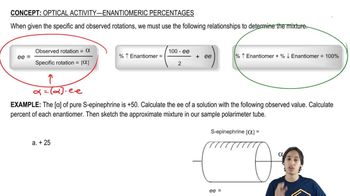
Determine the enantiomeric excess (ee) of the mixture. The enantiomeric excess is calculated using the formula: ee = |% major enantiomer - % minor enantiomer|. In this case, the major enantiomer is (-)-mandelic acid (75%) and the minor enantiomer is (+)-mandelic acid (25%).
Substitute the given percentages into the formula: ee = |75% - 25%|. This will give you the enantiomeric excess of the mixture.
The observed specific rotation of the mixture is proportional to the enantiomeric excess. Use the formula: [α]_obs = ee × [α]_pure, where [α]_pure is the specific rotation of the pure enantiomer. Here, [α]_pure for (+)-mandelic acid is given as +158.
Substitute the calculated enantiomeric excess (from step 2) and the specific rotation of the pure enantiomer (from the problem statement) into the formula: [α]_obs = ee × (+158).
Since the major enantiomer is (-)-mandelic acid, the observed specific rotation will have the opposite sign of the pure (+)-mandelic acid. Therefore, the final observed specific rotation will be negative.

Verified video answer for a similar problem:

This video solution was recommended by our tutors as helpful for the problem above.
Video duration:
3m
Was this helpful?

Key Concepts

Here are the essential concepts you must grasp in order to answer the question correctly.

Specific Rotation

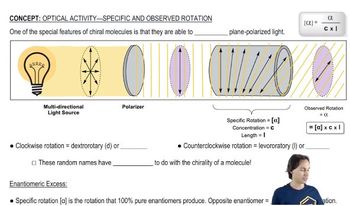
Specific rotation is a property of chiral compounds that quantifies their ability to rotate plane-polarized light. It is defined as the observed rotation of light at a specific wavelength and temperature, normalized to a concentration of 1 g/mL in a 1 dm path length. The specific rotation is a characteristic value for each enantiomer, allowing for the identification and quantification of chiral substances in mixtures.
Recommended video:
Guided course
05:43
Specific rotation vs. observed rotation.

Enantiomers

Enantiomers are pairs of molecules that are non-superimposable mirror images of each other, often differing in their optical activity. In the case of mandelic acid, (+)-mandelic acid and (-)-mandelic acid are enantiomers, each rotating plane-polarized light in opposite directions. Understanding the behavior of enantiomers is crucial for predicting the optical properties of mixtures containing both forms.
Recommended video:
Guided course
03:23
How to solve for the percentage of each enantiomer.

Optical Purity

Optical purity is a measure of the composition of a chiral mixture, expressed as the ratio of the observed specific rotation to the specific rotation of a pure enantiomer. It provides insight into the relative amounts of each enantiomer in a mixture. In the given question, calculating the observed specific rotation of the mixture involves applying the concept of optical purity to determine how the proportions of the enantiomers affect the overall rotation.
Recommended video:
Guided course
08:17
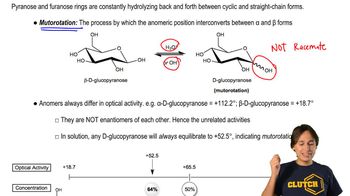
Mutorotation and Optical Activity
Related Practice
Textbook Question

The reaction of (R)-1-iodo-2-methylbutane with hydroxide ion forms an alcohol without breaking any bonds to the asymmetric center. The alcohol rotates the plane of polarization of plane-polarized light counterclockwise. What is the configuration of (+)-2-methyl-1-butanol?

Textbook Question

The following compound has only one asymmetric center. Why then does it have four stereoisomers?

1
views
Textbook Question

a. Stereoisomers with two asymmetric centers are called ___ if the configuration of both asymmetric centers in one stereoisomer is the opposite of the configuration of the symmetric centers in the other stereoisomer.

b. Stereoisomers with two asymmetric centers are called ___ if the configuration of both asymmetric centers in one stereoisomer is the same as the configuration of the asymmetric centers in the other stereoisomer.

c. Stereoisomers with two asymmetric centers are called ___ if one of the asymmetric centers has the same configuration in both stereoisomers and the other asymmetric center has the opposite configuration in the two stereoisomers.

5
views
Textbook Question

What is the configuration of the following compounds? (Use the given structures to answer the question.)

c. (++)-lactic acid

4
views
Textbook Question

The observed rotation of 2.0 g of a compound in 50 mL of solution in a polarimeter tube 20 cm long is +138°. What is the specific rotation of the compound?

Textbook Question

Naproxen, a nonsteroidal anti-inflammatory drug that is the active ingredient in Aleve (p. 115), has a specific rotation of +66. One commercial preparation results in a mixture with a 97% enantiomeric excess.

a. Does naproxen have the R or the S configuration?

b. What percent of each enantiomer is obtained from the commercial preparation?