Ch. 4 - Isomers: The Arrangement of Atoms in Space
Bruice - Organic Chemistry 8th Edition
Bruice8th EditionOrganic ChemistryISBN: 9780135213711Not the one you use?Change textbook
Chapter 5, Problem 38

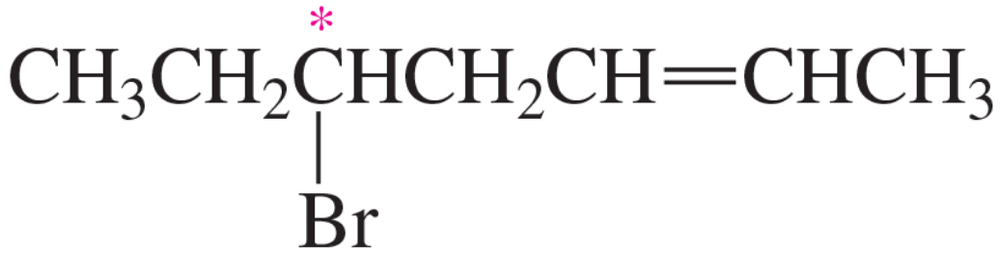
The following compound has only one asymmetric center. Why then does it have four stereoisomers?

Verified step by step guidance
1
Step 1: Identify the asymmetric center in the molecule. The asymmetric center is marked with an asterisk (*) and is the carbon atom bonded to four different groups: CH3CH2-, CH2CH=CHCH3, Br, and H.
Step 2: Recognize that the molecule also contains a double bond (CH=CH). Double bonds can exhibit geometric (cis/trans or E/Z) isomerism due to restricted rotation around the bond.
Step 3: Analyze the double bond for stereoisomerism. The groups attached to the double-bonded carbons are different, allowing for E/Z isomerism. E (entgegen) refers to opposite sides, and Z (zusammen) refers to the same side of the double bond.
Step 4: Combine the stereoisomerism from the asymmetric center and the double bond. The asymmetric center contributes two configurations (R and S), and the double bond contributes two configurations (E and Z). Together, this results in 2 × 2 = 4 stereoisomers.
Step 5: Conclude that the presence of both an asymmetric center and a stereogenic double bond leads to four stereoisomers, even though there is only one asymmetric center in the molecule.

Verified video answer for a similar problem:

This video solution was recommended by our tutors as helpful for the problem above.
Video duration:
4m
Was this helpful?

Key Concepts

Here are the essential concepts you must grasp in order to answer the question correctly.

Stereoisomerism

Stereoisomerism refers to the phenomenon where compounds have the same molecular formula and connectivity of atoms but differ in the spatial arrangement of those atoms. This can lead to different physical and chemical properties. In organic chemistry, stereoisomers can be classified into enantiomers and diastereomers, which are crucial for understanding the behavior of chiral molecules.
Recommended video:
Guided course
01:58
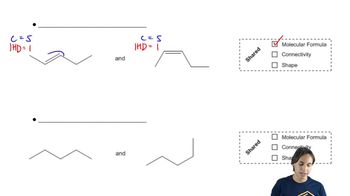
Determining when molecules are stereoisomers.

Chirality and Asymmetric Centers

Chirality is a property of a molecule that makes it non-superimposable on its mirror image, often due to the presence of an asymmetric center, typically a carbon atom bonded to four different substituents. While a molecule with one asymmetric center can have two enantiomers, the presence of additional elements, such as double bonds or rings, can lead to more stereoisomers due to restricted rotation or additional stereogenic centers.
Recommended video:
Guided course
05:41
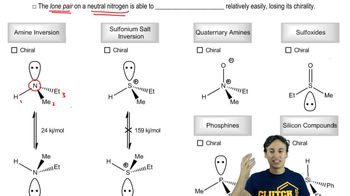
Understanding Other Chiral Atoms

Stereoisomer Counting

The maximum number of stereoisomers for a compound can be calculated using the formula 2^n, where n is the number of asymmetric centers. However, this formula does not account for symmetry or other structural features that may reduce the actual number of unique stereoisomers. In cases where a compound has one asymmetric center but additional symmetry or structural elements, the total number of stereoisomers can exceed the expected count based solely on asymmetric centers.
Recommended video:
Guided course
07:07
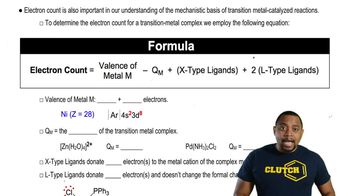
Electron Counting
Related Practice
Textbook Question

Draw the stereoisomers of the following amino acids. Indicate pairs of enantiomers and pairs of diastereomers.

a.

2
views

Textbook Question

a. Stereoisomers with two asymmetric centers are called ___ if the configuration of both asymmetric centers in one stereoisomer is the opposite of the configuration of the symmetric centers in the other stereoisomer.

b. Stereoisomers with two asymmetric centers are called ___ if the configuration of both asymmetric centers in one stereoisomer is the same as the configuration of the asymmetric centers in the other stereoisomer.

c. Stereoisomers with two asymmetric centers are called ___ if one of the asymmetric centers has the same configuration in both stereoisomers and the other asymmetric center has the opposite configuration in the two stereoisomers.

5
views
Textbook Question

(+)-Mandelic acid has a specific rotation of +158. What would be the observed specific rotation of each of the following mixtures?

c. 75% (-)-mandelic acid and 25% (+)-mandelic acid

1
views
Textbook Question

The stereoisomer of cholesterol found in nature is shown here.

a. How many asymmetric centers does cholesterol have?

b. What is the maximum number of stereoisomers that cholesterol can have?

1
views
Textbook Question

The observed rotation of 2.0 g of a compound in 50 mL of solution in a polarimeter tube 20 cm long is +138°. What is the specific rotation of the compound?

Textbook Question

Naproxen, a nonsteroidal anti-inflammatory drug that is the active ingredient in Aleve (p. 115), has a specific rotation of +66. One commercial preparation results in a mixture with a 97% enantiomeric excess.

a. Does naproxen have the R or the S configuration?

b. What percent of each enantiomer is obtained from the commercial preparation?