Butyric acid, the compound responsible for the unpleasant odor and taste of sour milk, has a pKa value of 4.82. What is its Ka value? Is it a stronger acid or a weaker acid than vitamin C?
Ch. 2 - Acids and Bases: Central to Understanding Organic Chemistry
All textbooks
Bruice 8th Edition
Ch. 2 - Acids and Bases: Central to Understanding Organic Chemistry
Problem 6a
Bruice 8th Edition
Ch. 2 - Acids and Bases: Central to Understanding Organic Chemistry
Problem 6aChapter 3, Problem 6a
An acid has a Ka of 4.53 × 10⁻⁶ in water. What is its Keq for reaction with water in a dilute solution? ([H2O] = 55.5 M)
Verified step by step guidance1
Step 1: Understand the relationship between Ka and Keq. Ka represents the acid dissociation constant, which is specific to the reaction of the acid with water. Keq, the equilibrium constant, can be calculated using the formula: Keq = Ka × [H2O], where [H2O] is the molar concentration of water in the solution.
Step 2: Identify the given values. From the problem, Ka = 4.53×10⁻⁶ and [H2O] = 55.5 M. These values will be used in the formula to calculate Keq.
Step 3: Write the formula for Keq explicitly using MathML:
Step 4: Substitute the given values into the formula. Replace Ka with 4.53×10⁻⁶ and [H2O] with 55.5 M in the equation.
Step 5: Perform the multiplication to find Keq. Multiply Ka by [H2O] to determine the equilibrium constant for the reaction. Ensure proper handling of significant figures and scientific notation during the calculation.

Verified video answer for a similar problem:
This video solution was recommended by our tutors as helpful for the problem above.
Video duration:
3mWas this helpful?
Key Concepts
Here are the essential concepts you must grasp in order to answer the question correctly.
Acid Dissociation Constant (Ka)
The acid dissociation constant (Ka) quantifies the strength of an acid in solution. It is defined as the equilibrium constant for the dissociation of an acid into its conjugate base and a proton. A higher Ka value indicates a stronger acid, as it dissociates more completely in water. In this case, the given Ka of 4.53×10⁻⁶ suggests a weak acid that partially ionizes in solution.
Recommended video:
Guided course
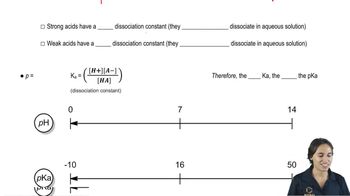
The relationship between equilibrium constant and pKa.
Equilibrium Constant (Keq)
The equilibrium constant (Keq) represents the ratio of the concentrations of products to reactants at equilibrium for a given reaction. For the dissociation of an acid in water, Keq can be derived from the Ka value, taking into account the concentration of water, which is typically treated as a constant in dilute solutions. Understanding Keq is essential for predicting the extent of the reaction and the concentrations of species at equilibrium.
Recommended video:
Guided course
The relationship between equilibrium constant and pKa.
Water as a Solvent
Water is often considered a solvent in acid-base reactions due to its high dielectric constant and ability to stabilize ions. In dilute solutions, the concentration of water is approximately 55.5 M, which can be factored into equilibrium calculations. This concentration allows for simplifications in the equilibrium expressions, as the activity of water is effectively constant, influencing the calculation of Keq for the acid's reaction with water.
Recommended video:
Guided course
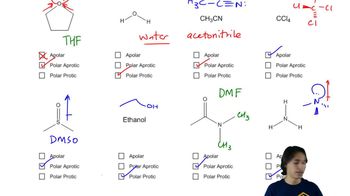
Identification of polarity in solvents
Related Practice
Textbook Question
1
views
Textbook Question
Draw the conjugate acid of each of the following:
a. CH3CH2OH
b. CH3CH2O−
c.
7
views
Textbook Question
What is the conjugate base of each of the following?
1. NH3
2. HBr
3. HNO3
4. H2O
1
views
Textbook Question
Antacids are compounds that neutralize stomach acid. Write the equations that show how Milk of Magnesia, Alka-Seltzer, and Tums remove excess acid.
a. Milk of Magnesia: Mg(OH)2
b. Alka-Seltzer: KHCO3 and NaHCO3
c. Tums: CaCO3
1
views
Textbook Question
What is the conjugate acid of each of the following?
1. NH3
2. Cl−
3. HO−
4. H2O
2
views
Textbook Question
a. Which is a stronger acid: one with a pKa of 5.2 or one with a pKa of 5.8?
b. Which is a stronger acid: one with an acid dissociation constant of 3.4 × 10⁻³ or one with an acid dissociation constant of 2.1 × 10⁻⁴?
1
views