Ch. 2 - Acids and Bases: Central to Understanding Organic Chemistry
Bruice - Organic Chemistry 8th Edition
Bruice8th EditionOrganic ChemistryISBN: 9780135213711Not the one you use?Change textbook
Chapter 3, Problem 7a

Butyric acid, the compound responsible for the unpleasant odor and taste of sour milk, has a pKa value of 4.82. What is its Ka value? Is it a stronger acid or a weaker acid than vitamin C?

Verified step by step guidance
1
Identify the relationship between pKa and Ka. The formula to convert pKa to Ka is: \( K_a = 10^{-pK_a} \). This formula is derived from the logarithmic definition of pKa.
Substitute the given pKa value of butyric acid (4.82) into the formula: \( K_a = 10^{-4.82} \).
Calculate the value of \( 10^{-4.82} \) to determine the Ka value of butyric acid. This step involves using a calculator or logarithmic rules.
Compare the Ka value of butyric acid to the Ka value of vitamin C. Vitamin C has a pKa of approximately 4.10, so its Ka can be calculated using the same formula: \( K_a = 10^{-4.10} \).
Analyze the results: A lower pKa corresponds to a higher Ka, indicating a stronger acid. Compare the Ka values of butyric acid and vitamin C to determine which is the stronger acid.

Verified video answer for a similar problem:

This video solution was recommended by our tutors as helpful for the problem above.
Video duration:
3m
Was this helpful?

Key Concepts

Here are the essential concepts you must grasp in order to answer the question correctly.

pKa and Ka Relationship

The pKa value is the negative logarithm of the acid dissociation constant (Ka) of a compound. It is calculated using the formula pKa = -log(Ka). A lower pKa value indicates a stronger acid, as it means the acid dissociates more completely in solution. To find Ka from pKa, you can use the equation Ka = 10^(-pKa).
Recommended video:
Guided course
07:45
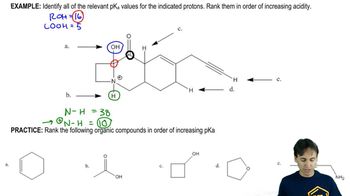
Identifying pKa values

Acid Strength Comparison

Acid strength is determined by the ability of an acid to donate protons (H+ ions) in solution. Stronger acids have higher Ka values and lower pKa values, indicating they dissociate more completely. To compare butyric acid with vitamin C, one must calculate the Ka values of both acids and analyze their dissociation tendencies in water.
Recommended video:
Guided course
03:09
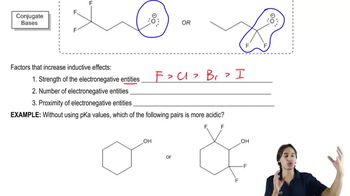
The 3 factors that determine the strength of inductive effects.

Butyric Acid and Vitamin C

Butyric acid (pKa 4.82) is a weak acid, while vitamin C (ascorbic acid) has a pKa around 4.1, indicating it is a stronger acid. By calculating the Ka values, one can determine that butyric acid has a lower dissociation constant than vitamin C, confirming that vitamin C is a stronger acid due to its greater tendency to donate protons in solution.
Recommended video:
Guided course
04:20
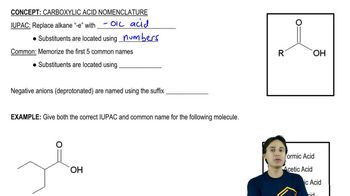
Carboxylic Acids Nomenclature