Ch. 15 - Conjugated Systems, Orbital Symmetry, and Ultraviolet Spectroscopy
Wade - Organic Chemistry 9th Edition
Wade9th EditionOrganic ChemistryISBN: 9780135213728Not the one you use?Change textbook
Chapter 15, Problem 25a

Predict the products of the following reactions.
(a) allyl bromide + cyclohexyl magnesium bromide

Verified step by step guidance
1
Identify the type of reaction: This reaction involves an organometallic reagent (cyclohexyl magnesium bromide, a Grignard reagent) and an alkyl halide (allyl bromide). Grignard reagents typically act as nucleophiles in reactions with electrophiles.
Analyze the reactivity of the Grignard reagent: The cyclohexyl magnesium bromide contains a cyclohexyl group bonded to magnesium. The carbon attached to magnesium is highly nucleophilic due to the polar carbon-magnesium bond.
Determine the electrophilic site in allyl bromide: In allyl bromide, the carbon bonded to the bromine atom is electrophilic because bromine is more electronegative and withdraws electron density from the carbon.
Predict the nucleophilic attack: The nucleophilic cyclohexyl group from the Grignard reagent will attack the electrophilic carbon of allyl bromide, displacing the bromide ion (Br⁻) as a leaving group. This results in the formation of a new carbon-carbon bond.
Write the product structure: The product will be an alkane where the cyclohexyl group is bonded to the allyl group (CH₂=CH-CH₂). The bromide ion (Br⁻) is a byproduct of the reaction.

Verified video answer for a similar problem:

This video solution was recommended by our tutors as helpful for the problem above.
Video duration:
2m
Was this helpful?

Key Concepts

Here are the essential concepts you must grasp in order to answer the question correctly.

Nucleophilic Substitution

Nucleophilic substitution is a fundamental reaction in organic chemistry where a nucleophile attacks an electrophile, resulting in the replacement of a leaving group. In the case of allyl bromide, the bromine atom acts as a leaving group, allowing the nucleophile (cyclohexyl magnesium bromide) to form a new bond with the carbon atom that was previously bonded to bromine.
Recommended video:
Guided course
01:47
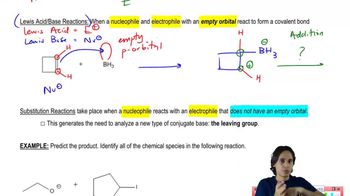
Nucleophiles and Electrophiles can react in Substitution Reactions.

Grignard Reagents

Grignard reagents are organomagnesium compounds that act as strong nucleophiles in organic reactions. Cyclohexyl magnesium bromide is a Grignard reagent that can react with electrophiles, such as allyl bromide, to form new carbon-carbon bonds. This reaction is crucial for building complex organic molecules and is a key tool in synthetic organic chemistry.
Recommended video:
Guided course
02:12
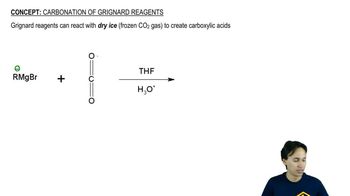
Carbonation of Grignard Reagents

Reaction Mechanism

Understanding the reaction mechanism is essential for predicting the products of organic reactions. In this case, the mechanism involves the nucleophilic attack of the Grignard reagent on the allyl bromide, leading to the formation of a new carbon-carbon bond. Analyzing the mechanism helps in anticipating the structure of the final product and understanding the steps involved in the reaction.
Recommended video:
Guided course
02:16
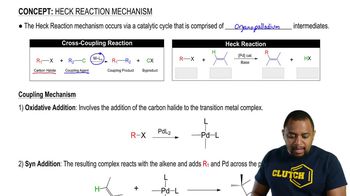
Heck Reaction Mechanism