Ch. 15 - Conjugated Systems, Orbital Symmetry, and Ultraviolet Spectroscopy
Wade - Organic Chemistry 9th Edition
Wade9th EditionOrganic ChemistryISBN: 9780135213728Not the one you use?Change textbook
Chapter 15, Problem 23

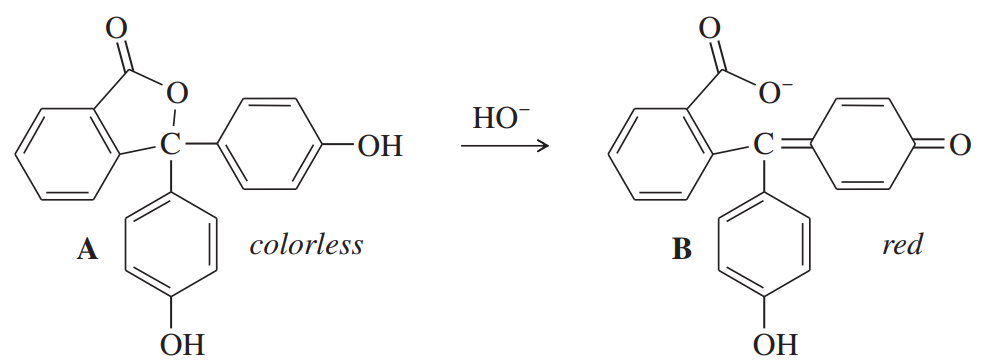
Phenolphthalein is an acid–base indicator that is colorless below pH 8 and red above pH 8. Explain briefly why the first structure is colorless and the second structure is colored.
Chemical structures showing phenolphthalein; left structure labeled colorless, right structure labeled red.

Verified step by step guidance
1
Step 1: Analyze the chemical structures provided in the image. Structure A (colorless) has a lactone ring, which is a cyclic ester. Structure B (red) has undergone a reaction with hydroxide ions (HO⁻), leading to the opening of the lactone ring and the formation of a conjugated system.
Step 2: Understand the role of conjugation in color. In organic molecules, conjugation refers to the overlap of p-orbitals across adjacent atoms, allowing delocalization of electrons. This delocalization lowers the energy gap between the molecule's highest occupied molecular orbital (HOMO) and lowest unoccupied molecular orbital (LUMO), enabling absorption of visible light and imparting color.
Step 3: Explain why structure A is colorless. In structure A, the lactone ring prevents extensive conjugation. The lack of a fully conjugated system means the molecule absorbs light in the ultraviolet region, which is not visible to the human eye, making it appear colorless.
Step 4: Explain why structure B is red. In structure B, the lactone ring is opened, creating a highly conjugated system that extends across the molecule. This conjugation allows the molecule to absorb light in the visible spectrum, specifically in the blue-green region, which results in the complementary color red being observed.
Step 5: Relate the pH dependency to the structural change. At pH below 8, the lactone ring remains intact (structure A), and the molecule is colorless. Above pH 8, hydroxide ions deprotonate the molecule, opening the lactone ring and forming the conjugated system (structure B), which is red.

Verified video answer for a similar problem:

This video solution was recommended by our tutors as helpful for the problem above.
Video duration:
1m
Was this helpful?

Key Concepts

Here are the essential concepts you must grasp in order to answer the question correctly.

Acid-Base Indicators

Acid-base indicators are substances that change color in response to changes in pH. They typically exist in two forms: one that is protonated (often colorless) and one that is deprotonated (often colored). The transition between these forms occurs at a specific pH range, allowing indicators like phenolphthalein to signal the acidity or basicity of a solution.
Recommended video:
Guided course
02:49
The Lewis definition of acids and bases.

Structural Changes in Phenolphthalein

Phenolphthalein has different structural forms depending on the pH of the solution. Below pH 8, it exists predominantly in a protonated form, which is colorless. Above pH 8, it loses a proton and transitions to a deprotonated form, which has a conjugated double bond system that absorbs visible light, resulting in a red color.
Recommended video:
Guided course
14:01
Drawing Contributing Structures

Conjugation and Color

The color of a compound is often related to its electronic structure, particularly the presence of conjugated systems. In phenolphthalein, the deprotonated form features a conjugated system of alternating double bonds, which allows for the absorption of specific wavelengths of light, leading to the observed color change. This phenomenon is a key principle in understanding how molecular structure influences color in organic compounds.
Recommended video:
Guided course
03:27
Conjugated states