Ch.6 - Alkyl Halides; Nucleophilic Substitution
Wade - Organic Chemistry 9th Edition
Wade9th EditionOrganic ChemistryISBN: 9780135213728Not the one you use?Change textbook
Chapter 6, Problem 42

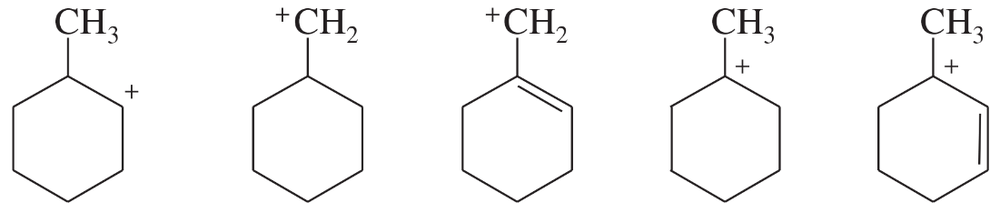
List the following carbocations in decreasing order of their stability.

Verified step by step guidance
1
Step 1: Analyze the stability of carbocations based on their structure. Carbocation stability is influenced by factors such as hyperconjugation, resonance, and inductive effects. Tertiary carbocations are generally more stable than secondary, which are more stable than primary carbocations.
Step 2: Examine the first structure. The carbocation is tertiary because the positively charged carbon is attached to three other carbons, including a methyl group. This structure benefits from hyperconjugation and inductive effects, making it highly stable.
Step 3: Examine the second structure. The carbocation is primary because the positively charged carbon is attached to only one other carbon. This structure lacks significant stabilizing effects, making it less stable.
Step 4: Examine the third structure. The carbocation is primary, but it is adjacent to a double bond, allowing for resonance stabilization. The positive charge can delocalize over the π-electrons of the double bond, increasing its stability compared to a simple primary carbocation.
Step 5: Examine the fourth structure. The carbocation is tertiary and adjacent to a double bond. This structure benefits from both hyperconjugation and resonance stabilization, making it the most stable among the given carbocations.

Verified video answer for a similar problem:

This video solution was recommended by our tutors as helpful for the problem above.
Video duration:
4m
Was this helpful?

Key Concepts

Here are the essential concepts you must grasp in order to answer the question correctly.

Carbocation Stability

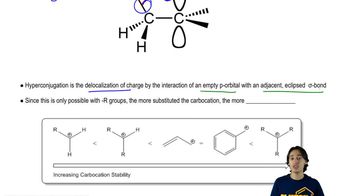
Carbocations are positively charged carbon species that are classified based on their degree of substitution: primary, secondary, and tertiary. Tertiary carbocations are the most stable due to hyperconjugation and the inductive effect from surrounding alkyl groups, which help to disperse the positive charge. In contrast, primary carbocations are the least stable, as they have fewer alkyl groups to stabilize the charge.
Recommended video:
Guided course
05:58
Determining Carbocation Stability

Hyperconjugation

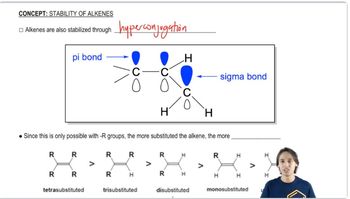
Hyperconjugation is a stabilizing interaction that occurs when the electrons in a sigma bond (usually C-H or C-C) interact with an adjacent empty p-orbital or a positively charged carbon. This interaction allows for the delocalization of charge, which stabilizes the carbocation. The more alkyl groups attached to the carbocation, the greater the hyperconjugation effect, leading to increased stability.
Recommended video:
Guided course
04:28
Understanding trends of alkene stability.

Inductive Effect

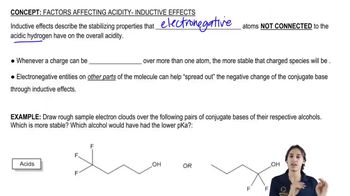
The inductive effect refers to the electron-donating or electron-withdrawing effects transmitted through sigma bonds in a molecule. Alkyl groups are electron-donating, which helps to stabilize a positive charge on a carbocation. The presence of more alkyl substituents increases the overall electron density around the carbocation, enhancing its stability compared to less substituted carbocations.
Recommended video:
Guided course
01:47
Understanding the Inductive Effect.