Ch. 2 - General Chemistry Translated: Finding the Electrons
Mullins - Organic Chemistry: A Learner Centered Approach 1st Edition
Mullins1st EditionOrganic Chemistry: A Learner Centered ApproachISBN: 9780137566471Not the one you use?Change textbook
Chapter 1, Problem 77e

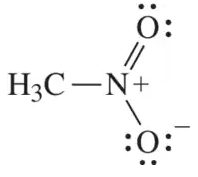
Given the Lewis structures, indicate the direction of the dipole moment, if there is one.
(e)

Verified step by step guidance
1
Examine the Lewis structure provided. The molecule consists of a methyl group (CH₃) attached to a positively charged nitrogen (N⁺), which is bonded to two oxygen atoms. One oxygen is double-bonded, and the other is single-bonded with a negative charge (O⁻).
Identify the electronegativity of the atoms involved. Oxygen is more electronegative than nitrogen, and nitrogen is more electronegative than carbon. This difference in electronegativity will influence the direction of the dipole moment.
Analyze the bonds individually. The N⁺-O double bond will have a dipole moment pointing toward the oxygen atom due to its higher electronegativity. Similarly, the N⁺-O⁻ single bond will also have a dipole moment pointing toward the oxygen atom, but the negative charge on the oxygen intensifies this dipole.
Consider the overall molecular geometry. The molecule is not symmetrical, and the dipole moments of the N⁺-O bonds do not cancel out. Additionally, the CH₃ group contributes a small dipole moment pointing toward the nitrogen due to the electronegativity difference between carbon and nitrogen.
Combine the dipole moments to determine the net dipole direction. The dipole moments from the N⁺-O bonds dominate, and the overall dipole moment will point toward the oxygen atoms, away from the CH₃ group.

Verified video answer for a similar problem:

This video solution was recommended by our tutors as helpful for the problem above.
Was this helpful?

Key Concepts

Here are the essential concepts you must grasp in order to answer the question correctly.

Lewis Structures

Lewis structures are diagrams that represent the bonding between atoms in a molecule and the lone pairs of electrons that may exist. They help visualize the arrangement of electrons and the connectivity of atoms, which is crucial for understanding molecular geometry and polarity.
Recommended video:
Guided course
04:12
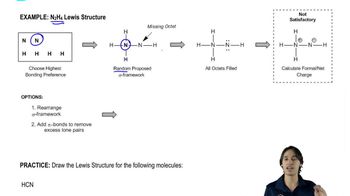
Drawing the Lewis Structure for N2H4.

Dipole Moment

A dipole moment is a measure of the separation of positive and negative charges in a molecule, indicating its polarity. It arises when there is an uneven distribution of electron density, leading to a partial positive charge on one end and a partial negative charge on the other, which can be represented as an arrow pointing from the positive to the negative end.
Recommended video:
Guided course
01:46
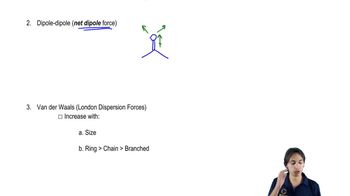
How dipole-dipole forces work.

Molecular Polarity

Molecular polarity refers to the distribution of electrical charge over the atoms in a molecule. A molecule is polar if it has a net dipole moment due to differences in electronegativity between bonded atoms, which affects its physical properties and interactions with other molecules, such as solubility and boiling point.
Recommended video:
Guided course
2:04
Molecular Polarity