Looking ahead in Chapter 4, we explain that molecules like CH3+ are Lewis acids or electron pair acceptors. Into which orbital would the new electron pair go?
Ch. 2 - General Chemistry Translated: Finding the Electrons

Mullins1st EditionOrganic Chemistry: A Learner Centered ApproachISBN: 9780137566471Not the one you use?Change textbook
All textbooks
Mullins 1st Edition
Ch. 2 - General Chemistry Translated: Finding the Electrons
Problem 80
Mullins 1st Edition
Ch. 2 - General Chemistry Translated: Finding the Electrons
Problem 80Chapter 1, Problem 80
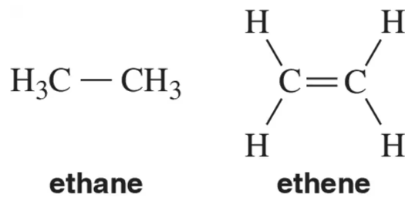
The C―H σ bond length in ethane is 1.09 Å. The C―H σ bond in ethene is 1.07 Å. Explain.

Verified step by step guidance1
The bond length of a C―H σ bond is influenced by the hybridization of the carbon atom involved in the bond. In ethane, the carbon atoms are sp³ hybridized, while in ethene, the carbon atoms are sp² hybridized.
The sp³ hybridization in ethane results in orbitals with 25% s-character and 75% p-character. In contrast, sp² hybridization in ethene results in orbitals with 33% s-character and 67% p-character.
Orbitals with higher s-character (as in sp² hybridization) are closer to the nucleus, leading to shorter bond lengths. This explains why the C―H bond in ethene (1.07 Å) is shorter than the C―H bond in ethane (1.09 Å).
The increased s-character in sp² hybridized orbitals also results in stronger and more tightly held bonds, contributing to the shorter bond length in ethene compared to ethane.
In summary, the difference in C―H bond lengths between ethane and ethene is due to the difference in hybridization of the carbon atoms, which affects the orbital characteristics and bond strength.

Verified video answer for a similar problem:
This video solution was recommended by our tutors as helpful for the problem above.
Was this helpful?
Key Concepts
Here are the essential concepts you must grasp in order to answer the question correctly.
Bond Length
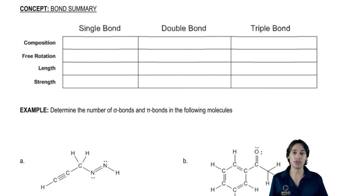
Bond length is the distance between the nuclei of two bonded atoms. It is influenced by the type of bond (single, double, or triple) and the atomic radii of the involved elements. In general, shorter bond lengths indicate stronger bonds due to increased overlap of atomic orbitals.
Recommended video:
Guided course
Single bonds, double bonds, and triple bonds.
Hybridization
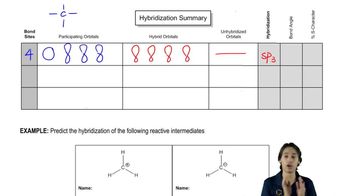
Hybridization is the concept of mixing atomic orbitals to form new hybrid orbitals that can accommodate bonding. In ethane (C2H6), carbon undergoes sp3 hybridization, resulting in single C―H bonds. In contrast, ethene (C2H4) features sp2 hybridization, leading to a double bond between carbons, which affects bond lengths.
Recommended video:
Guided course
Using bond sites to predict hybridization
Bond Order
Bond order refers to the number of chemical bonds between a pair of atoms. A higher bond order typically results in a shorter bond length and greater bond strength. Ethene has a bond order of 1.5 for the C―H bonds due to the presence of a double bond between the carbon atoms, which contributes to the shorter bond length compared to ethane.
Recommended video:
Guided course
Single bonds, double bonds, and triple bonds.
Related Practice
Textbook Question
2
views
Textbook Question
There is free rotation around the C―C bond in ethane. There is an extremely high barrier to rotation around the C=C bond in in ethene. Explain.
4
views
Textbook Question
In propene, the indicated C―C bond length is 1.51 Å. In the allyl cation, the indicated C―C bond length is 1.41 Å. Explain.
1
views
Textbook Question
Carbon dioxide (CO2) has no dipole moment (μ = 0 D). The related molecule sulfur dioxide (SO2) does have a dipole moment (μ = 1.6 D) Explain this observation.
5
views
Textbook Question
In comparison to CH3+ in Assessment 2.82, the related molecule H3O+ is not a Lewis acid at oxygen. Why?
1
views
Textbook Question
Given the Lewis structures, indicate the direction of the dipole moment, if there is one.
(e)
1
views