
Ch. 13 - Nuclear Magnetic Resonance Spectroscopy
Wade - Organic Chemistry 9th Edition
Wade9th EditionOrganic ChemistryISBN: 9780135213728Not the one you use?Change textbook
Chapter 13, Problem 54

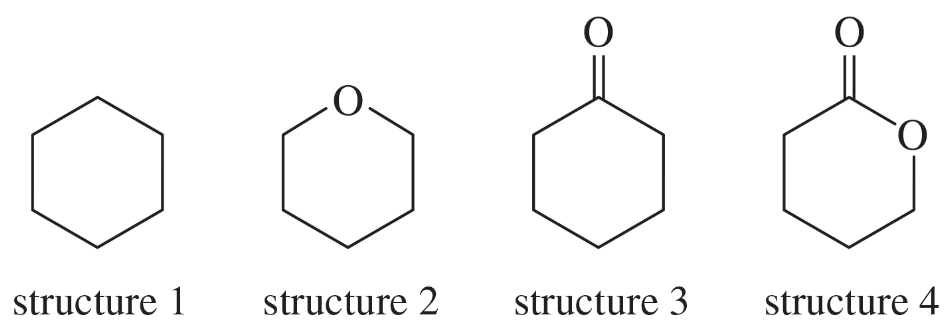
How many signals would you expect to see in the 13C NMR of the following compounds? In each case, show which carbon atoms are equivalent in the 13C NMR.

Verified step by step guidance
1
Step 1: Analyze the symmetry of each structure to determine which carbon atoms are equivalent. Equivalent carbons will produce the same signal in the 13C NMR spectrum.
Step 2: For structure (i), cyclohexane, all six carbon atoms are equivalent due to the high symmetry of the molecule. This results in one signal in the 13C NMR spectrum.
Step 3: For structure (ii), thiacyclohexane, the sulfur atom breaks the symmetry of the ring. The carbons adjacent to the sulfur are equivalent to each other, and the remaining carbons are equivalent in pairs. This results in three distinct signals in the 13C NMR spectrum.
Step 4: For structure (iii), cyclohexanone, the carbonyl group breaks the symmetry of the ring. The carbonyl carbon is unique, and the carbons adjacent to the carbonyl are equivalent to each other. The remaining carbons are equivalent in pairs. This results in four distinct signals in the 13C NMR spectrum.
Step 5: For structure (iv), cyclohexane-1,4-dione, the two carbonyl groups further reduce the symmetry. The carbonyl carbons are equivalent to each other, and the carbons adjacent to each carbonyl are equivalent in pairs. The remaining carbons are also equivalent in pairs. This results in three distinct signals in the 13C NMR spectrum.

Verified video answer for a similar problem:

This video solution was recommended by our tutors as helpful for the problem above.
Video duration:
5m
Was this helpful?

Key Concepts

Here are the essential concepts you must grasp in order to answer the question correctly.

Carbon NMR Spectroscopy

Carbon-13 NMR (Nuclear Magnetic Resonance) spectroscopy is a technique used to determine the structure of organic compounds by analyzing the magnetic environment of carbon atoms. Each unique carbon environment in a molecule produces a distinct signal in the NMR spectrum, allowing chemists to infer the number of different carbon types present.
Recommended video:
Guided course
04:00
13C NMR General Features

Chemical Equivalence

In NMR spectroscopy, chemically equivalent atoms are those that are in identical environments and thus produce the same signal. For carbon atoms, this means they are bonded to the same atoms and have the same electronic environment. Identifying equivalent carbons is crucial for predicting the number of signals in the NMR spectrum.
Recommended video:
3:11
Chemical Reactions of Phosphate Anhydrides Concept 1

Functional Groups and Their Effects

Functional groups, such as carbonyls and hydroxyls, significantly influence the chemical environment of adjacent carbon atoms, affecting their equivalence. For example, the presence of a carbonyl group can deshield nearby carbons, leading to shifts in their NMR signals. Understanding how functional groups interact with carbon atoms is essential for accurate NMR analysis.
Recommended video:
Guided course
02:36
Identifying Functional Groups
Related Practice
Textbook Question

Different types of protons and carbons in alkanes tend to absorb at similar chemical shifts, making structure determination difficult. Explain how the 13C NMR spectrum, including the DEPT technique, would allow you to distinguish among the following four isomers.

6
views
Textbook Question

Hexamethylbenzene undergoes free-radical chlorination to give one monochlorinated product (C12H17Cl) and four dichlorinated products (C12H16Cl2). These products are easily separated by GC-MS, but the dichlorinated products are difficult to distinguish by their mass spectra. Draw the monochlorinated product and the four dichlorinated products, and explain how 13C NMR would easily distinguish among these compounds.

4
views
Textbook Question

Show how you would distinguish among the following three compounds

(a) using infrared spectroscopy and no other information.

(b) using proton NMR spectroscopy and no other information.

(c) using 13C NMR, including DEPT, and no other information.

2
views
Textbook Question

Phenyl Grignard reagent adds to 2-methylpropanal to give the secondary alcohol shown. The proton NMR of 2-methylpropanal shows the two methyl groups as equivalent (one doublet at δ1.1), yet the product alcohol, a racemic mixture, shows two different 3H doublets, one at δ0.75 and one around δ1.0.

(a) Draw a Newman projection of the product along the C1–C2 axis.

(b) Explain why the two methyl groups have different NMR chemical shifts. What is the term applied to protons such as these?

1
views
Textbook Question

Each of these four structures has molecular formula C4H8O2. Match the structure with its characteristic proton NMR signals. (Not all of the signals are listed in each case.)

(a) sharp 1H singlet at δ8.0 and 2H triplet at δ4.0

(b) sharp 3H singlet at δ2.0 and 2H quartet at δ4.1

(c) sharp 3H singlet at δ3.7 and 2H quartet at δ2.3

(d) broad 1H singlet at δ11.5 and 2H triplet at δ2.3

2
views