
Ch. 13 - Nuclear Magnetic Resonance Spectroscopy
Wade - Organic Chemistry 9th Edition
Wade9th EditionOrganic ChemistryISBN: 9780135213728Not the one you use?Change textbook
Chapter 13, Problem 52

Hexamethylbenzene undergoes free-radical chlorination to give one monochlorinated product (C12H17Cl) and four dichlorinated products (C12H16Cl2). These products are easily separated by GC-MS, but the dichlorinated products are difficult to distinguish by their mass spectra. Draw the monochlorinated product and the four dichlorinated products, and explain how 13C NMR would easily distinguish among these compounds.

Verified step by step guidance
1
Step 1: Understand the structure of hexamethylbenzene. Hexamethylbenzene is a benzene ring with six methyl groups attached to each carbon of the aromatic ring. Its molecular formula is C12H18.
Step 2: Analyze the monochlorinated product. Free-radical chlorination replaces one hydrogen atom from one of the methyl groups with a chlorine atom. This results in a single monochlorinated product (C12H17Cl) because all six methyl groups are equivalent due to the symmetry of hexamethylbenzene.
Step 3: Analyze the dichlorinated products. Dichlorination involves replacing two hydrogens from two methyl groups with chlorine atoms. Due to the symmetry of hexamethylbenzene, there are four unique dichlorinated products (C12H16Cl2): (1) two chlorines on the same methyl group, (2) two chlorines on adjacent methyl groups, (3) two chlorines on methyl groups separated by one carbon, and (4) two chlorines on methyl groups opposite each other on the benzene ring.
Step 4: Explain how 13C NMR distinguishes these compounds. In 13C NMR, the chemical environment of each carbon atom is analyzed. The monochlorinated product will show a single new signal for the carbon attached to the chlorine atom, while the dichlorinated products will show distinct patterns based on the number and position of chlorinated carbons. The symmetry of the molecule will reduce the number of unique signals, making it easier to identify each product.
Step 5: Summarize the distinguishing features. The monochlorinated product will have one unique carbon signal for the chlorinated methyl group. The dichlorinated products will have different patterns of carbon signals depending on whether the chlorines are on the same methyl group, adjacent methyl groups, or more distant methyl groups. This makes 13C NMR a powerful tool for distinguishing these compounds.

Verified video answer for a similar problem:

This video solution was recommended by our tutors as helpful for the problem above.
Video duration:
8m
Was this helpful?

Key Concepts

Here are the essential concepts you must grasp in order to answer the question correctly.

Free-Radical Chlorination

Free-radical chlorination is a reaction mechanism where chlorine reacts with alkanes or aromatic compounds in the presence of heat or light, leading to the formation of chlorinated products. This process involves the generation of chlorine radicals, which abstract hydrogen atoms from the organic substrate, resulting in the substitution of hydrogen with chlorine. The selectivity of this reaction is influenced by the stability of the radicals formed, which is crucial for predicting the products in compounds like hexamethylbenzene.
Recommended video:
Guided course
03:03
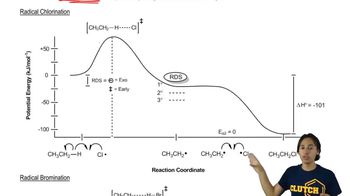
Using the Hammond Postulate to describe radical chlorination.

NMR Spectroscopy

Nuclear Magnetic Resonance (NMR) spectroscopy is a powerful analytical technique used to determine the structure of organic compounds. In 13C NMR, the different chemical environments of carbon atoms in a molecule lead to distinct resonance signals. This allows for the identification of various carbon types and their connectivity, making it particularly useful for distinguishing between isomers, such as the dichlorinated products of hexamethylbenzene, which may have subtle differences in their carbon environments.
Recommended video:
Guided course
10:06
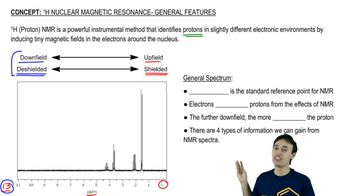
General NMR Features

Isomerism in Chlorinated Products

Isomerism refers to the existence of compounds with the same molecular formula but different structural arrangements or spatial orientations. In the case of hexamethylbenzene, the monochlorinated product has a single substitution, while the dichlorinated products can vary in the positions of the chlorine atoms on the aromatic ring. Understanding the types of isomers—structural and stereoisomers—helps in predicting the distinct properties and behaviors of these chlorinated derivatives, which can be analyzed using techniques like GC-MS and NMR.
Recommended video:
Guided course
00:48
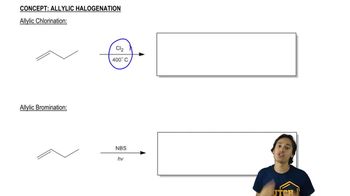
The products of Allylic Chlorination.
Related Practice
Textbook Question

Different types of protons and carbons in alkanes tend to absorb at similar chemical shifts, making structure determination difficult. Explain how the 13C NMR spectrum, including the DEPT technique, would allow you to distinguish among the following four isomers.

6
views
Textbook Question

The three isomers of dimethylbenzene are commonly named ortho-xylene, meta-xylene, and para-xylene. These three isomers are difficult to distinguish using proton NMR, but they are instantly identifiable using 13C NMR.

(a) Describe how carbon NMR distinguishes these three isomers.

(b) Explain why they are difficult to distinguish using proton NMR.

3
views
Textbook Question

(a) Draw all six isomers of formula C4H8 (including stereoisomers).

(b) For each structure, show how many types of H would appear in the proton NMR spectrum.

(c) For each structure, show how many types of C would appear in the 13C NMR spectrum.

(d) If an unknown compound of formula C4H8 shows two types of H and three types of C, can you determine its structure from this information?

1
views
Textbook Question

Phenyl Grignard reagent adds to 2-methylpropanal to give the secondary alcohol shown. The proton NMR of 2-methylpropanal shows the two methyl groups as equivalent (one doublet at δ1.1), yet the product alcohol, a racemic mixture, shows two different 3H doublets, one at δ0.75 and one around δ1.0.

(a) Draw a Newman projection of the product along the C1–C2 axis.

(b) Explain why the two methyl groups have different NMR chemical shifts. What is the term applied to protons such as these?

1
views
Textbook Question

Each of these four structures has molecular formula C4H8O2. Match the structure with its characteristic proton NMR signals. (Not all of the signals are listed in each case.)

(a) sharp 1H singlet at δ8.0 and 2H triplet at δ4.0

(b) sharp 3H singlet at δ2.0 and 2H quartet at δ4.1

(c) sharp 3H singlet at δ3.7 and 2H quartet at δ2.3

(d) broad 1H singlet at δ11.5 and 2H triplet at δ2.3

2
views
Textbook Question

How many signals would you expect to see in the 13C NMR of the following compounds? In each case, show which carbon atoms are equivalent in the 13C NMR.