
Ch. 13 - Nuclear Magnetic Resonance Spectroscopy
Wade - Organic Chemistry 9th Edition
Wade9th EditionOrganic ChemistryISBN: 9780135213728Not the one you use?Change textbook
Chapter 13, Problem 56

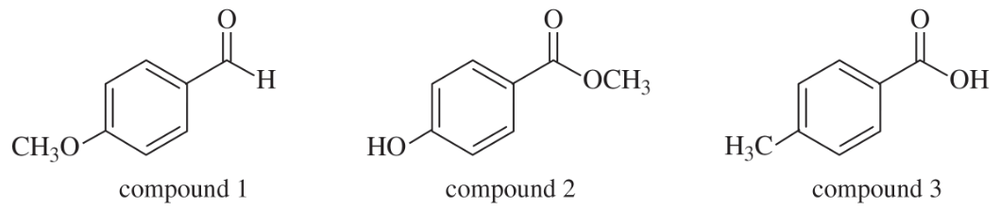
Show how you would distinguish among the following three compounds
(a) using infrared spectroscopy and no other information.
(b) using proton NMR spectroscopy and no other information.
(c) using 13C NMR, including DEPT, and no other information.

Verified step by step guidance
1
Step 1: Infrared Spectroscopy (IR) - Analyze the functional groups present in each compound. Compound 1 contains an aldehyde group (-CHO), which will show a strong absorption around 1720 cm⁻¹ for the C=O stretch and a characteristic aldehyde C-H stretch near 2700-2800 cm⁻¹. Compound 2 contains an ester group (-COOCH₃), which will show a strong absorption around 1740 cm⁻¹ for the C=O stretch and no aldehyde C-H stretch. Compound 3 contains a carboxylic acid group (-COOH), which will show a broad O-H stretch around 2500-3000 cm⁻¹ and a C=O stretch near 1710 cm⁻¹.
Step 2: Proton NMR (¹H NMR) - Examine the hydrogen environments. Compound 1 will show a distinct singlet for the aldehyde proton around 9-10 ppm. Compound 2 will show a singlet for the methyl group attached to the ester oxygen (-OCH₃) around 3.5-4 ppm. Compound 3 will show a broad singlet for the carboxylic acid proton (-COOH) around 10-12 ppm.
Step 3: Carbon NMR (¹³C NMR) - Analyze the carbon environments. Compound 1 will show a signal for the aldehyde carbon around 190-200 ppm. Compound 2 will show a signal for the ester carbonyl carbon around 170-180 ppm and a signal for the methyl carbon (-OCH₃) around 50-60 ppm. Compound 3 will show a signal for the carboxylic acid carbon around 170-180 ppm.
Step 4: DEPT Analysis - Use DEPT (Distortionless Enhancement by Polarization Transfer) to distinguish between CH, CH₂, and CH₃ groups. Compound 1 will show a CH signal for the aldehyde carbon. Compound 2 will show a CH₃ signal for the methyl group attached to the ester oxygen. Compound 3 will show no CH₃ signals but will show a CH signal for the aromatic carbons and a quaternary carbon for the carboxylic acid group.
Step 5: Compare the data from IR, ¹H NMR, and ¹³C NMR to distinguish the compounds. Each technique provides unique information about the functional groups and molecular structure, allowing for clear differentiation among the three compounds.

Verified video answer for a similar problem:

This video solution was recommended by our tutors as helpful for the problem above.
Video duration:
8m
Was this helpful?

Key Concepts

Here are the essential concepts you must grasp in order to answer the question correctly.

Infrared Spectroscopy (IR)

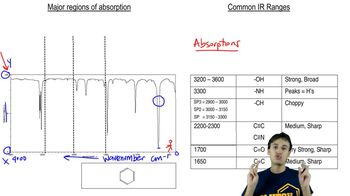
Infrared spectroscopy is a technique used to identify functional groups in organic compounds by measuring the absorption of infrared light. Different functional groups absorb characteristic wavelengths of IR radiation, leading to distinct peaks in the IR spectrum. For example, O-H stretches appear around 3200-3600 cm⁻¹, while C=O stretches are typically found around 1700 cm⁻¹. This allows for differentiation among compounds based on their functional groups.
Recommended video:
Guided course
16:04
General Features of IR Spect

Proton Nuclear Magnetic Resonance (1H NMR)

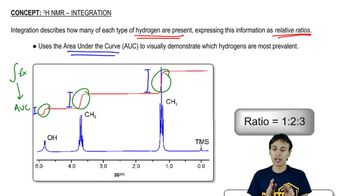
Proton NMR spectroscopy provides information about the hydrogen atoms in a molecule, revealing their environment and connectivity. The chemical shifts in the NMR spectrum indicate the electronic environment of the protons, while integration shows the relative number of protons. For instance, protons on a hydroxyl group (–OH) will resonate at different chemical shifts compared to those on a methyl group (–CH₃), allowing for the identification of different compounds based on their unique proton environments.
Recommended video:
Guided course
06:46
1H NMR Integration

Carbon-13 Nuclear Magnetic Resonance (13C NMR) and DEPT

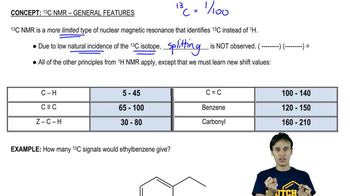
Carbon-13 NMR spectroscopy focuses on the carbon atoms in a molecule, providing insights into their chemical environment. The DEPT (Distortionless Enhancement by Polarization Transfer) technique enhances the visibility of specific carbon types, distinguishing between CH, CH₂, and CH₃ groups. This allows for a clearer interpretation of the carbon framework of the compounds, aiding in their differentiation based on the number and type of carbon environments present.
Recommended video:
Guided course
04:00
13C NMR General Features