Ch. 21 - Carboxylic Acid Derivatives
Wade - Organic Chemistry 9th Edition
Wade9th EditionOrganic ChemistryISBN: 9780135213728Not the one you use?Change textbook
Chapter 21, Problem 22

Propose a mechanism for the basic hydrolysis of benzonitrile to the benzoate ion and ammonia.

Verified step by step guidance
1
Identify the functional group in benzonitrile: The nitrile group (-C≡N) is a triple bond between carbon and nitrogen. In basic hydrolysis, this group is converted into a carboxylate ion (-COO⁻) and ammonia (NH₃).
Recognize the role of the base: The hydroxide ion (OH⁻) acts as a nucleophile and attacks the electrophilic carbon in the nitrile group, breaking the triple bond and forming an intermediate imidate ion.
Describe the intermediate hydrolysis step: The imidate ion undergoes further reaction with water, leading to the formation of an amide intermediate (benzamide). This step involves proton transfer and rearrangement.
Explain the second nucleophilic attack: The hydroxide ion attacks the carbonyl carbon of the amide, leading to the cleavage of the C-N bond and the formation of a tetrahedral intermediate.
Conclude with the final products: The tetrahedral intermediate collapses, releasing ammonia (NH₃) and forming the benzoate ion (C₆H₅COO⁻) as the final products of the reaction.

Verified video answer for a similar problem:

This video solution was recommended by our tutors as helpful for the problem above.
Video duration:
4m
Was this helpful?

Key Concepts

Here are the essential concepts you must grasp in order to answer the question correctly.

Nucleophilic Substitution

Nucleophilic substitution is a fundamental reaction mechanism in organic chemistry where a nucleophile attacks an electrophile, resulting in the replacement of a leaving group. In the case of benzonitrile hydrolysis, water acts as a nucleophile, attacking the carbon atom of the nitrile group, leading to the formation of an intermediate that eventually yields benzoate and ammonia.
Recommended video:
Guided course
01:47
Nucleophiles and Electrophiles can react in Substitution Reactions.

Hydrolysis of Nitriles

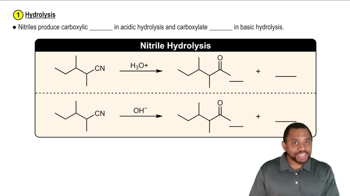
Hydrolysis of nitriles involves the reaction of a nitrile with water, typically under basic or acidic conditions, to convert it into a carboxylic acid and ammonia. In this process, the nitrile carbon is converted to a carboxylate ion, while the nitrogen is released as ammonia, highlighting the transformation of functional groups during the reaction.
Recommended video:
1:09
Review of Nitriles Concept 6

Reaction Mechanism

A reaction mechanism is a step-by-step description of the pathway taken during a chemical reaction, detailing the formation and breakdown of intermediates. Understanding the mechanism of benzonitrile hydrolysis is crucial, as it outlines the sequence of nucleophilic attack, intermediate formation, and final product generation, providing insight into the reaction's kinetics and thermodynamics.
Recommended video:
Guided course
02:16
Heck Reaction Mechanism