Ch. 21 - Carboxylic Acid Derivatives
Wade - Organic Chemistry 9th Edition
Wade9th EditionOrganic ChemistryISBN: 9780135213728Not the one you use?Change textbook
Chapter 21, Problem 24b

Propose a mechanism for the reduction of octanoyl chloride by lithium aluminum hydride.

Verified step by step guidance
1
Step 1: Recognize the functional groups involved. Octanoyl chloride is an acyl chloride, which is a reactive carboxylic acid derivative. Lithium aluminum hydride (LiAlH₄) is a strong reducing agent commonly used to reduce acyl chlorides to primary alcohols.
Step 2: Initiate the mechanism by identifying the nucleophilic attack. The hydride ion (H⁻) from LiAlH₄ acts as a nucleophile and attacks the carbonyl carbon of the octanoyl chloride. This forms a tetrahedral intermediate. Represent this step using the chemical equation: R-COCloctanoyl+HhydrideR-COHtetrahedral
Step 3: Describe the collapse of the tetrahedral intermediate. The intermediate collapses, expelling the chloride ion (Cl⁻) as a leaving group. This results in the formation of an aldehyde intermediate. Represent this step using the chemical equation: R-COHtetrahedralR-CHOaldehyde+Clleaving
Step 4: Explain the second reduction step. Another hydride ion (H⁻) from LiAlH₄ attacks the aldehyde intermediate, forming a second tetrahedral intermediate. This intermediate eventually collapses to yield the primary alcohol. Represent this step using the chemical equation: R-CHOaldehyde+HhydrideR-CH₂OHprimary
Step 5: Summarize the overall reaction. The reduction of octanoyl chloride by LiAlH₄ proceeds through two key steps: (1) reduction to an aldehyde intermediate, and (2) further reduction to a primary alcohol. The final product is octanol, a primary alcohol. Ensure to balance the reaction and account for all byproducts such as Cl⁻.

Verified video answer for a similar problem:

This video solution was recommended by our tutors as helpful for the problem above.
Video duration:
4m
Was this helpful?

Key Concepts

Here are the essential concepts you must grasp in order to answer the question correctly.

Reduction Reactions

Reduction reactions involve the gain of electrons or the decrease in oxidation state by a molecule. In organic chemistry, this often refers to the conversion of carbonyl compounds, like acyl chlorides, into alcohols. Understanding the principles of reduction is essential for proposing mechanisms, as it dictates how reactants interact and transform.
Recommended video:
Guided course
07:12
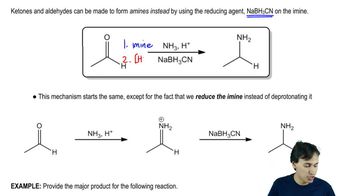
Reductive Amination

Lithium Aluminum Hydride (LiAlH4)

Lithium aluminum hydride is a powerful reducing agent commonly used in organic synthesis. It can donate hydride ions (H-) to electrophilic centers, such as carbonyl groups, facilitating their reduction. Recognizing its reactivity and mechanism of action is crucial for understanding how it reduces octanoyl chloride to octanol.
Recommended video:
Guided course
02:07
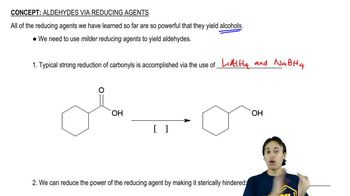
Why LiAlH4 doesn't work

Mechanism of Nucleophilic Acyl Substitution

The mechanism of nucleophilic acyl substitution describes how nucleophiles attack acyl compounds, leading to the replacement of a leaving group. In the case of octanoyl chloride, the hydride from LiAlH4 acts as a nucleophile, attacking the carbonyl carbon and forming an alkoxide intermediate. This concept is vital for detailing the stepwise process of the reduction.
Recommended video:
Guided course
01:47
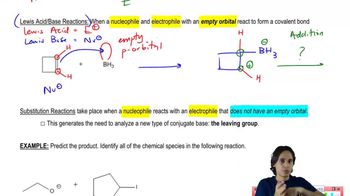
Nucleophiles and Electrophiles can react in Substitution Reactions.