Ch. 21 - Carboxylic Acid Derivatives
Wade - Organic Chemistry 9th Edition
Wade9th EditionOrganic ChemistryISBN: 9780135213728Not the one you use?Change textbook
Chapter 21, Problem 23

The mechanism for acidic hydrolysis of a nitrile resembles the basic hydrolysis, except that the nitrile is first protonated, activating it toward attack by a weak nucleophile (water). Under acidic conditions, the proton transfer (tautomerism) involves protonation on nitrogen followed by deprotonation on oxygen. Propose a mechanism for the acid-catalyzed hydrolysis of benzonitrile to benzamide.

Verified step by step guidance
1
Step 1: Protonation of the nitrile group - The lone pair of electrons on the nitrogen atom in the nitrile group of benzonitrile interacts with a proton (H⁺) from the acidic medium, resulting in the formation of a protonated nitrile intermediate. This step increases the electrophilicity of the carbon in the nitrile group.
Step 2: Nucleophilic attack by water - A water molecule, acting as a weak nucleophile, attacks the electrophilic carbon atom of the protonated nitrile. This leads to the formation of an intermediate that contains a positively charged nitrogen atom and a hydroxyl group attached to the carbon.
Step 3: Proton transfer (tautomerism) - The intermediate undergoes a proton transfer. The positively charged nitrogen atom loses a proton (deprotonation), and the hydroxyl group gains a proton (protonation), resulting in the formation of an imidic acid intermediate.
Step 4: Hydrolysis of the imidic acid - The imidic acid intermediate undergoes hydrolysis. A water molecule attacks the carbon atom of the imidic acid, leading to the cleavage of the C=N bond and the formation of a tetrahedral intermediate.
Step 5: Formation of benzamide - The tetrahedral intermediate undergoes proton transfers and rearrangements, ultimately resulting in the loss of an ammonium ion (NH₄⁺) and the formation of benzamide as the final product.

Verified video answer for a similar problem:

This video solution was recommended by our tutors as helpful for the problem above.
Video duration:
4m
Was this helpful?

Key Concepts

Here are the essential concepts you must grasp in order to answer the question correctly.

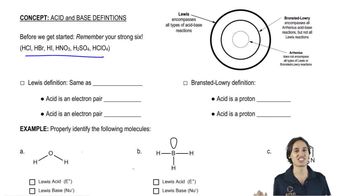
Acid-Base Chemistry

Acid-base chemistry is fundamental in organic reactions, particularly in mechanisms involving proton transfer. In the context of the hydrolysis of nitriles, the presence of an acid facilitates the protonation of the nitrile, making it more susceptible to nucleophilic attack. Understanding how acids donate protons and how bases accept them is crucial for predicting reaction pathways.
Recommended video:
Guided course
02:49
The Lewis definition of acids and bases.

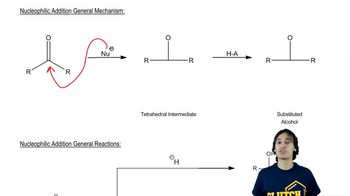
Nucleophilic Attack

Nucleophilic attack is a key step in many organic reactions, where a nucleophile donates an electron pair to an electrophile. In the case of acidic hydrolysis of benzonitrile, water acts as a weak nucleophile that attacks the protonated nitrile. Recognizing the role of nucleophiles and the conditions that enhance their reactivity is essential for understanding the mechanism.
Recommended video:
Guided course
08:27
Nucleophilic Addition

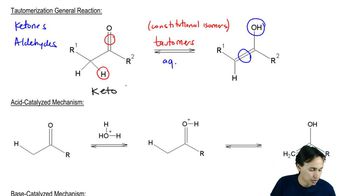
Tautomerism

Tautomerism refers to the rapid interconversion between two isomeric forms, typically involving the relocation of a proton. In the acidic hydrolysis of nitriles, tautomerism plays a role in the proton transfer process, where the nitrogen is protonated and subsequently, the oxygen is deprotonated. Grasping the concept of tautomerism helps in visualizing the steps involved in the reaction mechanism.
Recommended video:
Guided course
05:11
Tautomerization Mechanisms