Ch. 2 - Acids and Bases; Functional Groups
Wade - Organic Chemistry 9th Edition
Wade9th EditionOrganic ChemistryISBN: 9780135213728Not the one you use?Change textbook
Chapter 2, Problem 10a,b,c

Write equations for the following acid–base reactions. Use the information in Table 2-2 or Appendix 4 to predict whether the equilibrium will favor the reactants or the products.
a. HCOOH + CN
b. CH3COO + CH3OH
c. (CH3)2CHOH + NaNH2

Verified step by step guidance
1
Identify the acid and base in each reaction. For reaction (a), HCOOH is the acid and -CN is the base. For reaction (b), CH3COO- is the base and CH3OH is the acid. For reaction (c), (CH3)2CHOH is the base and CH3OH is the acid.
Write the chemical equation for each reaction. For (a), the equation is: HCOOH + -CN → HCOO- + HCN. For (b), the equation is: CH3COO- + CH3OH → CH3COOH + CH3O-. For (c), the equation is: (CH3)2CHOH + CH3OH → (CH3)2CHO- + CH3OH2+.
Determine the pKa values of the acids and conjugate acids involved in each reaction using the provided tables. For (a), pKa of HCOOH is 3.76 and pKa of HCN is 9.22. For (b), pKa of CH3OH is 15.5 and pKa of CH3COOH is 4.74. For (c), pKa of CH3OH is 15.5 and pKa of (CH3)2CHOH is 15.9.
Predict the direction of equilibrium based on the pKa values. The equilibrium will favor the side with the weaker acid (higher pKa value). For (a), equilibrium favors the products because HCN is a weaker acid than HCOOH. For (b), equilibrium favors the reactants because CH3OH is a weaker acid than CH3COOH. For (c), equilibrium slightly favors the reactants because (CH3)2CHOH is a weaker acid than CH3OH.
Summarize the findings: In reaction (a), the equilibrium favors the formation of HCOO- and HCN. In reaction (b), the equilibrium favors the formation of CH3COO- and CH3OH. In reaction (c), the equilibrium slightly favors the formation of (CH3)2CHOH and CH3OH.

Verified video answer for a similar problem:

This video solution was recommended by our tutors as helpful for the problem above.
Video duration:
7m
Was this helpful?

Key Concepts

Here are the essential concepts you must grasp in order to answer the question correctly.

Acid-Base Reactions

Acid-base reactions involve the transfer of protons (H+) between reactants. An acid donates a proton, while a base accepts it. Understanding the nature of the reactants and products as acids or bases is crucial for predicting the direction of the reaction and writing balanced chemical equations.
Recommended video:
Guided course
02:49
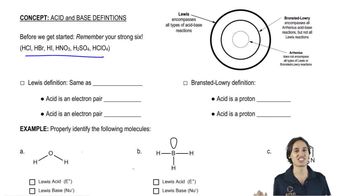
The Lewis definition of acids and bases.

Equilibrium and Reaction Favorability

In chemical reactions, equilibrium refers to the state where the rates of the forward and reverse reactions are equal. The position of equilibrium indicates whether reactants or products are favored. This can be predicted using the relative strengths of acids and bases, often found in tables of pKa values, where a lower pKa indicates a stronger acid.
Recommended video:
Guided course
04:00
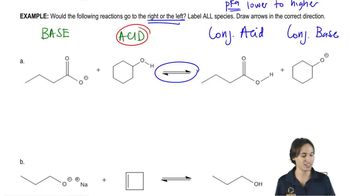
Determining Acid/Base Equilibrium

pKa and Acid-Base Strength

The pKa value is a quantitative measure of the strength of an acid in solution. It is the negative logarithm of the acid dissociation constant (Ka). A lower pKa value indicates a stronger acid, which more readily donates protons. Comparing pKa values of the acids and conjugate acids in a reaction helps predict the direction of equilibrium.
Recommended video:
Guided course
07:45
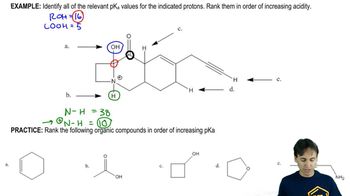
Identifying pKa values
Related Practice
Textbook Question

Calculate the pH of the following solutions.

a. 5.00 g of HBr in 100 mL of aqueous solution

b. 1.50 g of NaOH in 50 mL of aqueous solution

2
views

Textbook Question

Ammonia appears in [TABLE 2-2 ] as both an acid and a conjugate base. a. Explain how ammonia can act as both an acid and a base. Which of these roles does it commonly fill in aqueous solutions?

b. Show how water can serve as both an acid and a base.

1
views
Textbook Question

Ammonia appears in [TABLE 2-2] as both an acid and a conjugate base.

d. Show how methanol (CH3OH) can serve as both an acid and a base. Write an equation for the reaction of methanol with sulfuric acid.

Textbook Question

Ethanol, methylamine, and acetic acid are all amphoteric, reacting as either acids or bases depending on the conditions.

a. Rank ethanol, methylamine, and acetic acid in decreasing order of acidity. In each case, show the equation for the reaction with a generic base (B:) to give the conjugate base.

1
views
Textbook Question

Ethanol, methylamine, and acetic acid are all amphoteric, reacting as either acids or bases depending on the conditions.

b. Rank ethanol, methylamine, and acetic acid in decreasing order of basicity. In each case, show the equation for the reaction with a generic acid (HA) to give the conjugate acid.

3
views
Textbook Question

For each of the following reactions, suggest which solvent(s) would be compatible with the acids and bases involved. (We will ignore any other possible reactions for now.) Your choices of solvents are pentane, diethyl ether, ethanol, water, and ammonia. Refer to Appendix 4 for any needed values of pKa, or estimate them.

a. CH3Li + H—C≡C—H → CH4 + H—C≡CLi

b. CH3Li + (CH3)3C—OH → CH4 + (CH3)3C—OLi

2
views