
Ammonia appears in [TABLE 2-2 ] as both an acid and a conjugate base. a. Explain how ammonia can act as both an acid and a base. Which of these roles does it commonly fill in aqueous solutions?
b. Show how water can serve as both an acid and a base.
Verified step by step guidance
Ammonia appears in [TABLE 2-2 ] as both an acid and a conjugate base. a. Explain how ammonia can act as both an acid and a base. Which of these roles does it commonly fill in aqueous solutions?
b. Show how water can serve as both an acid and a base.
Ammonia appears in [TABLE 2-2] as both an acid and a conjugate base.
d. Show how methanol (CH3OH) can serve as both an acid and a base. Write an equation for the reaction of methanol with sulfuric acid.
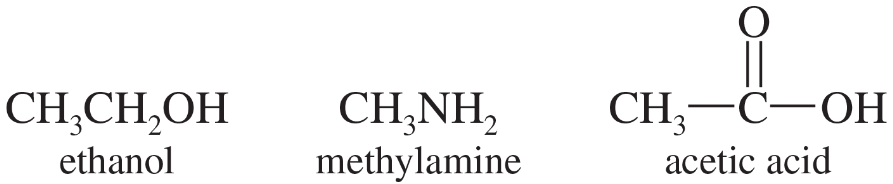
Ethanol, methylamine, and acetic acid are all amphoteric, reacting as either acids or bases depending on the conditions.
b. Rank ethanol, methylamine, and acetic acid in decreasing order of basicity. In each case, show the equation for the reaction with a generic acid (HA) to give the conjugate acid.
For each of the following reactions, suggest which solvent(s) would be compatible with the acids and bases involved. (We will ignore any other possible reactions for now.) Your choices of solvents are pentane, diethyl ether, ethanol, water, and ammonia. Refer to Appendix 4 for any needed values of pKa, or estimate them.
c.
d.
Write equations for the following acid–base reactions. Use the information in Table 2-2 or Appendix 4 to predict whether the equilibrium will favor the reactants or the products.
a. HCOOH + –CN
b. CH3COO– + CH3OH
c. (CH3)2CHOH + NaNH2
For each of the following reactions, suggest which solvent(s) would be compatible with the acids and bases involved. (We will ignore any other possible reactions for now.) Your choices of solvents are pentane, diethyl ether, ethanol, water, and ammonia. Refer to Appendix 4 for any needed values of pKa, or estimate them.
a. CH3Li + H—C≡C—H → CH4 + H—C≡CLi
b. CH3Li + (CH3)3C—OH → CH4 + (CH3)3C—OLi