Ch. 17 - Reactions of Aromatic Compounds
Wade - Organic Chemistry 9th Edition
Wade9th EditionOrganic ChemistryISBN: 9780135213728Not the one you use?Change textbook
Chapter 17, Problem 27b

What products would you expect from the following reactions?
(b) Chemical reaction diagram showing reactants and conditions for the Heck reaction, including structures and reagents.

Verified step by step guidance
1
Step 1: Recognize the reaction type. This is a Heck reaction, a palladium-catalyzed coupling reaction between an aryl or vinyl halide and an alkene.
Step 2: Identify the reactants. The first reactant is an alkyl bromide (1-bromo-2-butene), and the second reactant is an alkene with a methoxy-substituted benzene ring (4-methoxystyrene).
Step 3: Understand the role of the catalyst and base. Pd(OAc)₂ (palladium acetate) is the catalyst, PPh₃ (triphenylphosphine) is the ligand, and Et₃N (triethylamine) acts as the base to facilitate the reaction.
Step 4: Predict the coupling. The palladium catalyst facilitates the formation of a carbon-carbon bond between the alkene of 4-methoxystyrene and the carbon attached to the bromine in 1-bromo-2-butene. The reaction typically occurs at the less substituted end of the alkene in the styrene derivative.
Step 5: Consider regioselectivity. The product will likely be formed by the addition of the alkene to the terminal carbon of the 1-bromo-2-butene, resulting in a substituted alkene product with the methoxybenzene group attached.

Verified video answer for a similar problem:

This video solution was recommended by our tutors as helpful for the problem above.
Video duration:
4m
Was this helpful?

Key Concepts

Here are the essential concepts you must grasp in order to answer the question correctly.

Reaction Mechanisms

Understanding reaction mechanisms is crucial in organic chemistry as they describe the step-by-step process by which reactants transform into products. This includes identifying intermediates, transition states, and the movement of electrons. Familiarity with mechanisms helps predict the products of a reaction based on the nature of the reactants and the conditions applied.
Recommended video:
Guided course
02:16
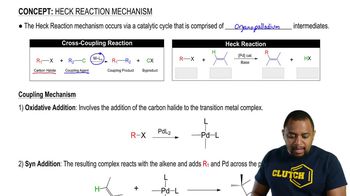
Heck Reaction Mechanism

Functional Groups

Functional groups are specific groups of atoms within molecules that are responsible for the characteristic chemical reactions of those molecules. Recognizing functional groups allows chemists to predict reactivity and the types of products that can be formed during chemical reactions. Common functional groups include alcohols, carboxylic acids, and amines, each influencing the reaction pathway.
Recommended video:
Guided course
02:36
Identifying Functional Groups

Stereochemistry

Stereochemistry involves the study of the spatial arrangement of atoms in molecules and how this affects their chemical behavior. It is essential for understanding isomerism, where compounds with the same molecular formula can have different structures and properties. Stereochemical considerations can significantly influence the products of reactions, especially in chiral environments.
Recommended video:
1:38
Polymer Stereochemistry Concept 1