Ch.10 - Structure and Synthesis of Alcohols
Wade - Organic Chemistry 9th Edition
Wade9th EditionOrganic ChemistryISBN: 9780135213728Not the one you use?Change textbook
Chapter 10, Problem 45

Geminal diols, or 1,1-diols, are usually unstable, spontaneously losing water to give carbonyl compounds. Therefore, geminal diols are regarded as hydrated forms of ketones and aldehydes. Propose a mechanism for the acid-catalyzed loss of water from propane-2,2-diol to give acetone.

Verified step by step guidance
1
Step 1: Protonation of one of the hydroxyl groups in propane-2,2-diol occurs under acidic conditions. This increases the electrophilicity of the carbon atom attached to the hydroxyl groups.
Step 2: The protonated hydroxyl group becomes a good leaving group, and water is eliminated, forming a carbocation intermediate at the central carbon atom.
Step 3: A rearrangement occurs where the lone pair of electrons from the remaining hydroxyl group stabilizes the carbocation by forming a double bond between the central carbon and oxygen, resulting in the formation of a carbonyl group.
Step 4: The protonated carbonyl group loses a proton to regenerate the acid catalyst, yielding acetone as the final product.
Step 5: The overall reaction results in the conversion of propane-2,2-diol to acetone with the elimination of water, driven by the stability of the carbonyl group formed.

Verified video answer for a similar problem:

This video solution was recommended by our tutors as helpful for the problem above.
Video duration:
4m
Was this helpful?

Key Concepts

Here are the essential concepts you must grasp in order to answer the question correctly.

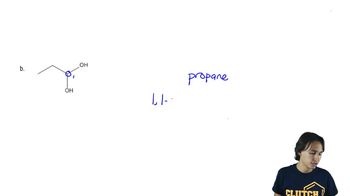
Geminal Diols

Geminal diols, also known as 1,1-diols, are organic compounds that contain two hydroxyl (-OH) groups attached to the same carbon atom. They are typically unstable and can readily dehydrate to form carbonyl compounds, such as aldehydes or ketones. This transformation is significant in organic chemistry as it illustrates the equilibrium between hydrated forms and their corresponding carbonyl species.
Recommended video:
Guided course
00:59
Provide the correct common and IUPAC name.

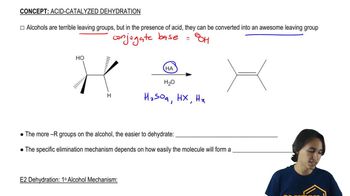
Acid-Catalyzed Dehydration

Acid-catalyzed dehydration is a chemical reaction where an acid facilitates the removal of water from a compound. In the case of geminal diols, the presence of an acid protonates the hydroxyl group, making it a better leaving group. This process leads to the formation of a carbocation intermediate, which subsequently loses a water molecule to yield a carbonyl compound, such as a ketone or aldehyde.
Recommended video:
Guided course
06:01
General features of acid-catalyzed dehydration.

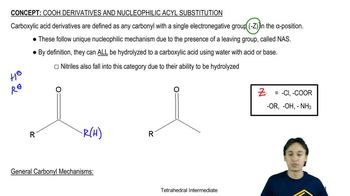
Mechanism of Carbonyl Formation

The mechanism of carbonyl formation from geminal diols involves several key steps: protonation of the hydroxyl group, formation of a carbocation, and elimination of water. The carbocation can rearrange or stabilize through resonance, leading to the formation of a stable carbonyl compound. Understanding this mechanism is crucial for predicting the behavior of similar organic compounds and their transformations in various chemical environments.
Recommended video:
Guided course
03:50
Intro to Carboxylic Acid Derivatives