
Ch.10 - Structure and Synthesis of Alcohols
Wade - Organic Chemistry 9th Edition
Wade9th EditionOrganic ChemistryISBN: 9780135213728Not the one you use?Change textbook
Chapter 10, Problem 46a

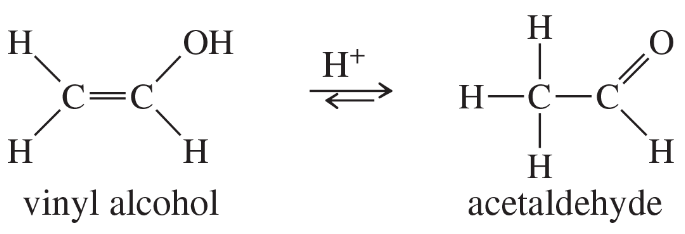
Vinyl alcohols are generally unstable, quickly isomerizing to carbonyl compounds. Propose mechanisms for the following isomerizations.
(a)

Verified step by step guidance
1
Step 1: Recognize that the reaction involves the isomerization of a vinyl alcohol to a carbonyl compound (aldehyde). This process is catalyzed by an acid (H⁺), which facilitates the rearrangement.
Step 2: Protonation of the hydroxyl group (-OH) occurs first. The lone pair of electrons on the oxygen atom of the hydroxyl group interacts with the H⁺, forming a positively charged oxonium ion (R-C=C-OH₂⁺).
Step 3: The oxonium ion undergoes a rearrangement. The π-electrons from the double bond migrate to stabilize the positive charge on the oxygen, forming a carbocation intermediate (R-C⁺-CH₂).
Step 4: A water molecule (H₂O) is eliminated from the intermediate, leaving behind a resonance-stabilized carbocation. This carbocation is then stabilized further by the migration of a hydrogen atom (1,2-hydride shift) to form the carbonyl group.
Step 5: Deprotonation occurs to regenerate the catalyst (H⁺), resulting in the final aldehyde product (CH₃CH₂CHO). This completes the isomerization mechanism.

Verified video answer for a similar problem:

This video solution was recommended by our tutors as helpful for the problem above.
Video duration:
6m
Was this helpful?

Key Concepts

Here are the essential concepts you must grasp in order to answer the question correctly.

Tautomerization

Tautomerization is a chemical reaction that involves the rearrangement of bonds within a compound, typically resulting in the interconversion between two isomers, known as tautomers. In the case of vinyl alcohols, tautomerization occurs between the enol form (vinyl alcohol) and the keto form (carbonyl compound). This process is often facilitated by proton transfer, leading to the stabilization of the more thermodynamically favorable carbonyl compound.
Recommended video:
Guided course
05:11
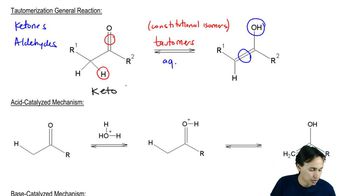
Tautomerization Mechanisms

Proton Transfer Mechanism

The proton transfer mechanism is a fundamental process in organic chemistry where a proton (H+) is transferred from one atom to another, often facilitating reactions such as tautomerization. In the context of vinyl alcohols, the transfer of a proton from the hydroxyl group to the adjacent carbon atom leads to the formation of a carbonyl compound. This mechanism is crucial for understanding how unstable vinyl alcohols can quickly convert to more stable forms.
Recommended video:
3:05
Polyurethane Mechanism Example 1

Stability of Carbonyl Compounds

Carbonyl compounds, characterized by the presence of a carbon-oxygen double bond (C=O), are generally more stable than their corresponding enol forms due to resonance stabilization and lower energy configurations. The stability of carbonyl compounds is a key factor in the isomerization of vinyl alcohols, as the reaction tends to favor the formation of the more stable carbonyl product. Understanding this stability helps explain the driving force behind the tautomerization process.
Recommended video:
Guided course
05:58
Determining Carbocation Stability
Related Practice
Textbook Question

Compound A (C7H11Br) is treated with magnesium in ether to give B (C7H11MgBr), which reacts violently with D2O to give 1-methylcyclohexene with a deuterium atom on the methyl group (C). Reaction of B with acetone (CH3COCH3) followed by hydrolysis gives D (C10H18O). Heating D with concentrated H2SO4 gives E (C10H16), which decolorizes two equivalents of Br2 to give F (C10H16Br4). E undergoes hydrogenation with excess H2 and a Pt catalyst to give isobutylcyclohexane. Determine the structures of compounds A through F, and show your reasoning throughout.

1
views
Textbook Question

Vinyl alcohols are generally unstable, quickly isomerizing to carbonyl compounds. Propose mechanisms for the following isomerizations.

(c)

1
views
Textbook Question

Geminal diols, or 1,1-diols, are usually unstable, spontaneously losing water to give carbonyl compounds. Therefore, geminal diols are regarded as hydrated forms of ketones and aldehydes. Propose a mechanism for the acid-catalyzed loss of water from propane-2,2-diol to give acetone.

7
views
Textbook Question

Vinyl alcohols are generally unstable, quickly isomerizing to carbonyl compounds. Propose mechanisms for the following isomerizations.

(b)

1
views
Textbook Question

Show how you would synthesize the following compounds from any starting materials containing no more than six carbon atoms.

(a)

1
views
Textbook Question

Show how you would synthesize the following compounds from any starting materials containing no more than six carbon atoms.

(b)

2
views