Ch.10 - Structure and Synthesis of Alcohols
Wade - Organic Chemistry 9th Edition
Wade9th EditionOrganic ChemistryISBN: 9780135213728Not the one you use?Change textbook
Chapter 10, Problem 44a

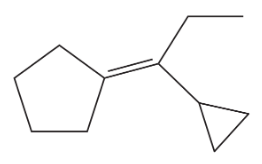
Show how you would synthesize the following compounds from any starting materials containing no more than six carbon atoms.
(a)

Verified step by step guidance
1
Step 1: Analyze the target molecule. The compound contains a cyclopentane ring, a double bond, and a cyclopropyl group attached to the double bond. The synthesis will require constructing the cyclopentane ring, introducing the double bond, and attaching the cyclopropyl group.
Step 2: Start with a six-carbon compound such as 1-bromo-2-pentene. This compound can serve as a precursor for the cyclopentane ring formation via an intramolecular reaction.
Step 3: Perform a ring-closing reaction to form the cyclopentane ring. This can be achieved using a base to induce an intramolecular nucleophilic substitution reaction, forming the cyclopentane structure.
Step 4: Introduce the cyclopropyl group. Use a cyclopropyl Grignard reagent (e.g., cyclopropylmagnesium bromide) to react with the double bond in the cyclopentene structure via a carbocation intermediate or a similar mechanism.
Step 5: Verify the stereochemistry and connectivity of the final product to ensure it matches the target molecule. Adjust reaction conditions if necessary to optimize yield and selectivity.

Verified video answer for a similar problem:

This video solution was recommended by our tutors as helpful for the problem above.
Video duration:
11m
Was this helpful?

Key Concepts

Here are the essential concepts you must grasp in order to answer the question correctly.

Functional Groups

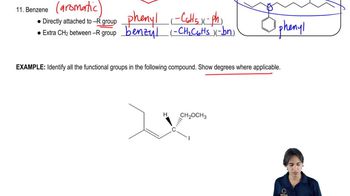
Functional groups are specific groups of atoms within molecules that are responsible for the characteristic chemical reactions of those molecules. Understanding the functional groups present in the target compound is essential for determining the appropriate reactions and starting materials needed for synthesis.
Recommended video:
Guided course
02:36
Identifying Functional Groups

Reactions and Mechanisms

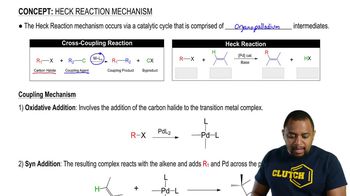
Organic synthesis often involves a series of chemical reactions, each with its own mechanism. Familiarity with common reactions such as nucleophilic substitutions, eliminations, and additions is crucial for planning a synthetic route. Knowing how to manipulate these reactions allows chemists to build complex molecules from simpler precursors.
Recommended video:
Guided course
02:16
Heck Reaction Mechanism

Carbon Skeleton Construction

The carbon skeleton of a molecule refers to the arrangement of carbon atoms in its structure. In organic synthesis, constructing the correct carbon skeleton is vital, especially when working with compounds that have specific ring structures or branching. Strategies such as cyclization and chain elongation are often employed to achieve the desired carbon framework.
Recommended video:
Guided course
03:18
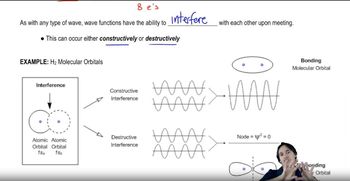
Constructive vs. destructive interference.