Ch. 18 - Reactions of Benzene and Substituted Benzenes
Bruice - Organic Chemistry 8th Edition
Bruice8th EditionOrganic ChemistryISBN: 9780135213711Not the one you use?Change textbook
Chapter 19, Problem 66a

Use the four compounds shown below to answer the following questions:
Four aromatic compounds with carboxylic acid groups and their pKa values displayed.
a. Why are the ortho-halo-substituted benzoic acids stronger acids than benzoic acid?

Verified step by step guidance
1
Step 1: Begin by analyzing the structure of benzoic acid (compound A). Benzoic acid consists of a benzene ring attached to a carboxylic acid group (-COOH). The acidity of benzoic acid is influenced by the electron-withdrawing or electron-donating effects of substituents on the benzene ring.
Step 2: Examine the ortho-substituted nitrobenzoic acid (compound B). The nitro group (-NO₂) is an electron-withdrawing group due to its strong inductive and resonance effects. When positioned ortho to the carboxylic acid group, it stabilizes the conjugate base (benzoate ion) by delocalizing the negative charge through resonance.
Step 3: Consider the proximity of the nitro group in compound B. The ortho position allows for additional stabilization via intramolecular hydrogen bonding between the nitro group and the carboxylic acid group. This further increases the acidity of the compound compared to unsubstituted benzoic acid.
Step 4: Compare compound B (ortho-nitrobenzoic acid) with compound C (meta-nitrobenzoic acid) and compound D (para-nitrobenzoic acid). While the nitro group in the meta and para positions also exerts an electron-withdrawing effect, the ortho position provides the strongest stabilization due to the combination of inductive effects, resonance effects, and intramolecular hydrogen bonding.
Step 5: Conclude that ortho-halo-substituted benzoic acids (or ortho-nitrobenzoic acids in this case) are stronger acids than benzoic acid because the substituent at the ortho position enhances the stabilization of the conjugate base through resonance and intramolecular interactions, making it easier for the compound to donate a proton.

Verified video answer for a similar problem:

This video solution was recommended by our tutors as helpful for the problem above.
Video duration:
3m
Was this helpful?

Key Concepts

Here are the essential concepts you must grasp in order to answer the question correctly.

Acidity and Acid Strength

Acidity refers to the ability of a compound to donate protons (H+ ions) in solution. The strength of an acid is determined by its dissociation constant (Ka), which indicates how completely it ionizes in water. Stronger acids have higher Ka values, meaning they release protons more readily. In the context of benzoic acid and its derivatives, substituents can influence acidity by stabilizing or destabilizing the conjugate base formed after deprotonation.
Recommended video:
Guided course
03:09
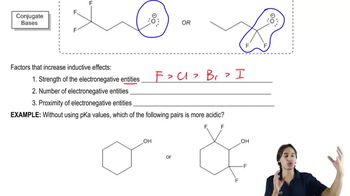
The 3 factors that determine the strength of inductive effects.

Inductive Effect

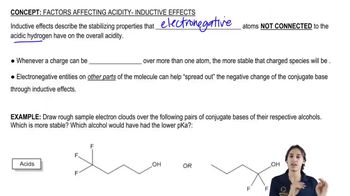
The inductive effect is the transmission of charge through a chain of atoms in a molecule due to the electronegativity of nearby atoms. Electron-withdrawing groups, such as nitro (-NO2), can stabilize the negative charge on the conjugate base of an acid, thereby increasing its acidity. In ortho-substituted benzoic acids, the proximity of the nitro group enhances this effect, making these acids stronger than benzoic acid itself.
Recommended video:
Guided course
01:47
Understanding the Inductive Effect.

Resonance Stabilization

Resonance stabilization occurs when a molecule can be represented by multiple valid Lewis structures, allowing for the delocalization of electrons. In the case of nitro-substituted benzoic acids, the resonance structures can distribute the negative charge of the conjugate base over several atoms, further stabilizing it. This stabilization is particularly pronounced in ortho-substituted compounds, where the nitro group can participate in resonance with the carboxylate group, enhancing acidity.
Recommended video:
Guided course
03:43
The radical stability trend.