Ch. 18 - Reactions of Benzene and Substituted Benzenes
Bruice - Organic Chemistry 8th Edition
Bruice8th EditionOrganic ChemistryISBN: 9780135213711Not the one you use?Change textbook
Chapter 19, Problem 67a

a. Rank the following esters from most reactive to least reactive in the first slow step of a nucleophilic acyl substitution reaction (formation of the tetrahedral intermediate):

Verified step by step guidance
1
Step 1: Understand the reactivity of esters in nucleophilic acyl substitution reactions. The first slow step involves the attack of a nucleophile on the carbonyl carbon, forming a tetrahedral intermediate. The reactivity depends on the electronic effects of substituents attached to the ester group.
Step 2: Analyze the substituents attached to the ester oxygen in each compound. Electron-withdrawing groups (EWGs) increase the electrophilicity of the carbonyl carbon, making it more reactive. Electron-donating groups (EDGs) decrease the electrophilicity, making the ester less reactive.
Step 3: Examine compound A. It has a chlorine atom attached to a benzene ring, which is an electron-withdrawing group. This increases the reactivity of the ester by stabilizing the partial positive charge on the carbonyl carbon.
Step 4: Examine compound B. It has a cyclohexyl group, which is an electron-donating group. This decreases the reactivity of the ester by reducing the electrophilicity of the carbonyl carbon.
Step 5: Compare compound C and D. Compound C has a benzene ring, which is less electron-withdrawing than the chlorinated benzene ring in compound D. Compound D has two chlorine atoms attached to the benzene ring, making it the most electron-withdrawing and therefore the most reactive ester in the series.

Verified video answer for a similar problem:

This video solution was recommended by our tutors as helpful for the problem above.
Video duration:
5m
Was this helpful?

Key Concepts

Here are the essential concepts you must grasp in order to answer the question correctly.

Nucleophilic Acyl Substitution

Nucleophilic acyl substitution is a fundamental reaction in organic chemistry where a nucleophile attacks the carbonyl carbon of an acyl compound, leading to the formation of a tetrahedral intermediate. This reaction is characterized by the replacement of a leaving group (often a carboxylic acid derivative) with a nucleophile. The reactivity of the acyl compound is influenced by the nature of the leaving group and the electronic effects of substituents on the carbonyl carbon.
Recommended video:
Guided course
01:47
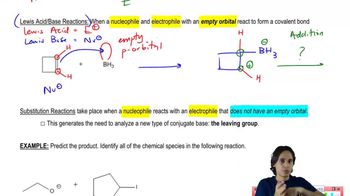
Nucleophiles and Electrophiles can react in Substitution Reactions.

Reactivity of Esters

The reactivity of esters in nucleophilic acyl substitution is determined by the stability of the leaving group and the electronic environment around the carbonyl. Electron-withdrawing groups, such as halogens, increase the electrophilicity of the carbonyl carbon, making the ester more reactive. Conversely, electron-donating groups can decrease reactivity by stabilizing the carbonyl, making it less susceptible to nucleophilic attack.
Recommended video:
Guided course
02:39
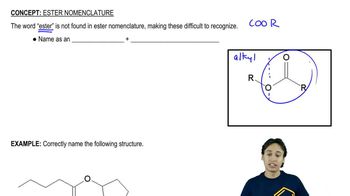
Ester Nomenclature

Tetrahedral Intermediate

The tetrahedral intermediate is a key species formed during nucleophilic acyl substitution. It results from the nucleophile's attack on the carbonyl carbon, leading to a temporary four-coordinate structure. The stability of this intermediate is crucial for the reaction's progression; if it is stable, the reaction is more likely to proceed to completion, while an unstable intermediate may lead to a slower reaction or revert to starting materials.
Recommended video:
Guided course
04:31
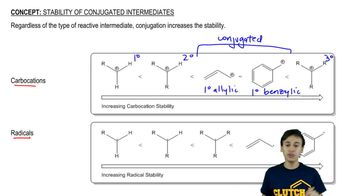
Stability of Conjugated Intermediates