


Ch. 18 - Reactions of Benzene and Substituted Benzenes
Bruice - Organic Chemistry 8th Edition
Bruice8th EditionOrganic ChemistryISBN: 9780135213711Not the one you use?Change textbook
Chapter 19, Problem 66b

Use the four compounds shown below to answer the following questions:
Four aromatic compounds with carboxylic acid groups and their pKa values displayed.
b. Why is o-fluorobenzoic acid the weakest of the ortho-halo-substituted benzoic acids?

Verified step by step guidance
1
Step 1: Analyze the structure of o-fluorobenzoic acid (not shown in the image but implied in the question). It is a benzoic acid derivative with a fluorine atom in the ortho position relative to the carboxylic acid group.
Step 2: Understand the concept of acidity in benzoic acids. The acidity is influenced by the electron-withdrawing or electron-donating effects of substituents on the benzene ring. Electron-withdrawing groups stabilize the conjugate base, increasing acidity, while electron-donating groups destabilize the conjugate base, decreasing acidity.
Step 3: Compare the inductive and resonance effects of fluorine with other halogens. Fluorine is highly electronegative and exerts a strong inductive electron-withdrawing effect. However, fluorine's resonance effect is weak because it does not effectively overlap with the π-system of the benzene ring due to its small size.
Step 4: Consider the ortho effect. In ortho-substituted benzoic acids, steric hindrance can interfere with the resonance stabilization of the conjugate base. Fluorine, being small, causes less steric hindrance compared to larger halogens like bromine, which can enhance acidity through steric effects.
Step 5: Conclude that o-fluorobenzoic acid is the weakest acid among ortho-halo-substituted benzoic acids because its inductive effect is strong but its resonance effect is weak, and the steric hindrance is minimal, leading to less stabilization of the conjugate base compared to other ortho-halo-substituted benzoic acids.

Verified video answer for a similar problem:

This video solution was recommended by our tutors as helpful for the problem above.
Video duration:
7m
Was this helpful?

Key Concepts

Here are the essential concepts you must grasp in order to answer the question correctly.

Acidity and Substituent Effects

The acidity of carboxylic acids is influenced by the presence of substituents on the aromatic ring. Electron-withdrawing groups, such as nitro or halogens, can stabilize the negative charge on the carboxylate ion formed after deprotonation, enhancing acidity. Conversely, electron-donating groups can decrease acidity by destabilizing the carboxylate ion.
Recommended video:
2:02
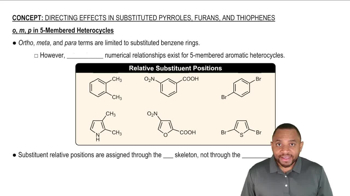
Directing Effects in Substituted Pyrroles, Furans, and Thiophenes Concept 1

Ortho Effect

The ortho effect refers to the increased acidity of ortho-substituted acids compared to their meta or para counterparts. This phenomenon occurs due to steric and electronic interactions between the substituent and the carboxylic acid group, which can enhance the stability of the conjugate base. In the case of o-fluorobenzoic acid, the fluorine's electronegativity and steric hindrance can lead to a weaker acid.
Recommended video:
2:02
Directing Effects in Substituted Pyrroles, Furans, and Thiophenes Concept 1

Comparative Analysis of Substituents

When comparing the acidity of ortho-halo-substituted benzoic acids, it is essential to analyze the nature of each substituent. For instance, the nitro group is a strong electron-withdrawing group, significantly increasing acidity, while the methyl group is electron-donating, decreasing acidity. The presence of fluorine in o-fluorobenzoic acid, while electronegative, does not stabilize the conjugate base as effectively as other substituents, making it the weakest acid in this series.
Recommended video:
Guided course
02:41
Comparing hydrocarbon acidity