
Textbook Question
Show how you would make the following ethers, using only simple alcohols and any needed reagents as your starting materials.
(a) 1-methoxybutane
(b) 2-ethoxy-2-methylpropane
(c) benzyl cyclopentyl ether
4
views

 Verified step by step guidance
 08:27
08:27
 01:52
01:52 03:
03:Show how you would make the following ethers, using only simple alcohols and any needed reagents as your starting materials.
(a) 1-methoxybutane
(b) 2-ethoxy-2-methylpropane
(c) benzyl cyclopentyl ether
Give IUPAC names for the following compounds.
(g)
(h)
(i)
(A true story.) An inexperienced graduate student moved into a laboratory and began work. He needed some diethyl ether for a reaction, so he opened an old, rusty 1-gallon can marked 'ethyl ether' and found there was half a gallon left. To purify the ether, the student set up a distillation apparatus, started a careful distillation, and went to the stockroom for the other reagents he needed. While he was at the stockroom, the student heard a muffled "boom." He quickly returned to his lab to find a worker from another laboratory putting out a fire. Most of the distillation apparatus was embedded in the ceiling.
(a) Explain what probably happened.
(b) Explain how this near-disaster might have been prevented.
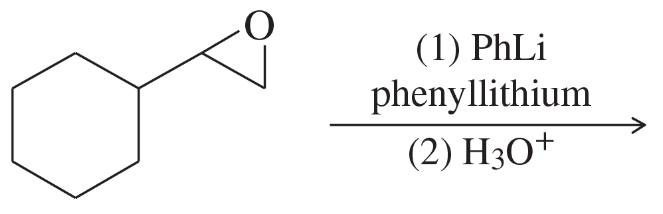
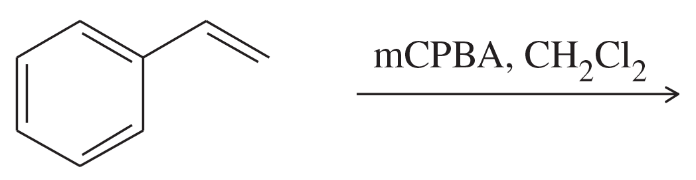
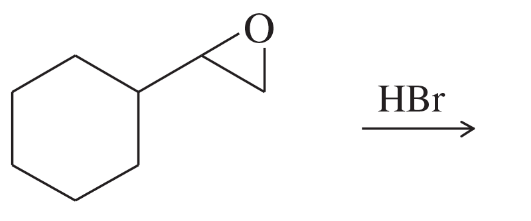
Predict the products of the following reactions.
(a) sec-butyl isopropyl ether + concd. HBr, heat
(b) 2-ethoxy-2-methylpentane + concd. HBr, heat
(c) di-n-butyl ether + hot concd. NaOH
Predict the products of the following reactions.
(g) trans-2,3-epoxyoctane + H+, H2O
(h) propylene oxide + methylamine (CH3NH2)
Predict the products of the following reactions.
(m)
(n)