Ch. 14 - Ethers, Epoxides, and Thioethers
Wade - Organic Chemistry 9th Edition
Wade9th EditionOrganic ChemistryISBN: 9780135213728Not the one you use?Change textbook
Chapter 14, Problem 33g,h

Predict the products of the following reactions.
(g) trans-2,3-epoxyoctane + H+, H2O
(h) propylene oxide + methylamine (CH3NH2)

Verified step by step guidance
1
Step 1: Understand the reaction type for each case. Both reactions involve epoxides, which are three-membered cyclic ethers. Epoxides are highly strained and reactive, and they undergo ring-opening reactions under acidic or nucleophilic conditions.
Step 2: For reaction (g), trans-2,3-epoxyoctane + H+, H2O: In acidic conditions, the epoxide ring opens via protonation of the oxygen atom by H+. This makes the oxygen more electrophilic, allowing water (H2O) to attack the more substituted carbon of the epoxide (Markovnikov regioselectivity). The result is a diol (a molecule with two hydroxyl groups).
Step 3: For reaction (h), propylene oxide + methylamine (CH3NH2): In the presence of a nucleophile like methylamine, the epoxide undergoes a nucleophilic ring-opening reaction. The nucleophile (CH3NH2) attacks the less substituted carbon of the epoxide (anti-Markovnikov regioselectivity) due to steric hindrance. This results in the formation of a β-amino alcohol.
Step 4: Consider the stereochemistry of the products. For reaction (g), the trans-epoxide will lead to anti-addition of the hydroxyl groups, meaning the two hydroxyl groups will end up on opposite sides of the molecule. For reaction (h), the nucleophilic attack by methylamine will also proceed with inversion of configuration at the carbon being attacked.
Step 5: Write the structures of the products. For reaction (g), the product is trans-2,3-octanediol. For reaction (h), the product is 2-(methylamino)-1-propanol. Ensure you draw the correct stereochemistry for each product based on the reaction mechanism.

Verified video answer for a similar problem:

This video solution was recommended by our tutors as helpful for the problem above.
Video duration:
10m
Was this helpful?

Key Concepts

Here are the essential concepts you must grasp in order to answer the question correctly.

Epoxide Reactivity

Epoxides are three-membered cyclic ethers that are highly reactive due to the strain in their ring structure. They can undergo ring-opening reactions in the presence of nucleophiles or acids. The reaction typically involves the nucleophile attacking the less hindered carbon atom of the epoxide, leading to the formation of a diol or other products depending on the reagents used.
Recommended video:
Guided course
02:19
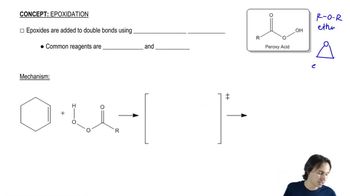
General properties of epoxidation.

Acid-Catalyzed Hydrolysis

In acid-catalyzed hydrolysis, an epoxide reacts with water in the presence of an acid (H+) to form a diol. The acid protonates the oxygen of the epoxide, making the ring more susceptible to nucleophilic attack by water. This process results in the opening of the epoxide ring and the formation of two hydroxyl groups on adjacent carbon atoms.
Recommended video:
Guided course
03:09
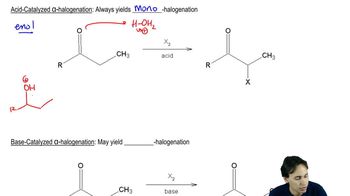
Acid Catalyzed

Nucleophilic Substitution

Nucleophilic substitution is a fundamental reaction mechanism in organic chemistry where a nucleophile replaces a leaving group in a molecule. In the case of propylene oxide reacting with methylamine, the amine acts as a nucleophile, attacking the less hindered carbon of the epoxide. This reaction leads to the formation of an amine-substituted product, typically resulting in the opening of the epoxide and the creation of a new bond with the nucleophile.
Recommended video:
Guided course
01:47
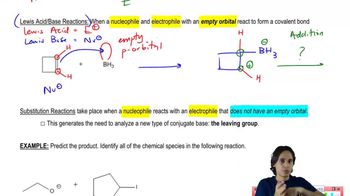
Nucleophiles and Electrophiles can react in Substitution Reactions.