Ch. 20 - The Organic Chemistry of Carbohydrates
Bruice - Organic Chemistry 8th Edition
Bruice8th EditionOrganic ChemistryISBN: 9780135213711Not the one you use?Change textbook
Chapter 21, Problem 36a

Identify the sugar in each description.
a. An aldopentose that is not D-arabinose forms D-arabinitol when it is reduced with NaBH4.

Verified step by step guidance
1
Step 1: Understand the problem. The question asks us to identify an aldopentose (a five-carbon sugar with an aldehyde group) that is not D-arabinose but forms D-arabinitol upon reduction with sodium borohydride (NaBH4). Reduction of an aldose with NaBH4 converts the aldehyde group (-CHO) into a primary alcohol (-CH2OH), resulting in a sugar alcohol (alditol).
Step 2: Recall the structure of D-arabinose. D-arabinose is an aldopentose with a specific stereochemistry at its chiral centers. When reduced, it forms D-arabinitol, a sugar alcohol with the same stereochemistry as D-arabinose.
Step 3: Consider other aldopentoses. The aldopentoses include D-ribose, D-xylose, D-lyxose, and D-arabinose. Since the problem specifies that the sugar is not D-arabinose, we need to determine which of the remaining aldopentoses also forms D-arabinitol upon reduction.
Step 4: Analyze stereochemistry. Reduction of an aldopentose preserves the stereochemistry of its chiral centers. Therefore, the aldopentose that forms D-arabinitol upon reduction must have the same stereochemical configuration as D-arabinose at all chiral centers except the carbonyl carbon (C1).
Step 5: Identify the sugar. Compare the stereochemistry of the remaining aldopentoses (D-ribose, D-xylose, and D-lyxose) to that of D-arabinose. The aldopentose with the same stereochemistry as D-arabinose at C2, C3, and C4 is the correct answer. This sugar will form D-arabinitol upon reduction with NaBH4.

Verified video answer for a similar problem:

This video solution was recommended by our tutors as helpful for the problem above.
Video duration:
6m
Was this helpful?

Key Concepts

Here are the essential concepts you must grasp in order to answer the question correctly.

Aldopentose

An aldopentose is a type of monosaccharide that contains five carbon atoms and an aldehyde functional group. The general formula for aldopentoses is C5H10O5. Understanding the structure and properties of aldopentoses is crucial for identifying specific sugars based on their chemical reactions and transformations.
Recommended video:
Guided course
02:42
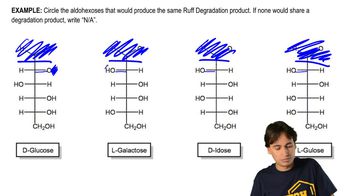
Which aldohexoses produce the same Ruff Degradation product

Reduction with NaBH4

Sodium borohydride (NaBH4) is a common reducing agent used in organic chemistry to convert carbonyl groups (aldehydes and ketones) into alcohols. When an aldopentose is reduced with NaBH4, the aldehyde group is transformed into a primary alcohol, leading to the formation of sugar alcohols, such as d-arabinitol in this case.
Recommended video:
Guided course
07:12
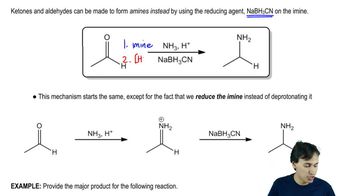
Reductive Amination

Sugar Alcohols

Sugar alcohols, or polyols, are organic compounds derived from sugars by reducing the carbonyl group to an alcohol group. They are often used as sweeteners and have different physical properties compared to their parent sugars. Recognizing the relationship between sugars and their corresponding sugar alcohols is essential for understanding biochemical pathways and reactions in organic chemistry.
Recommended video:
Guided course
02:21
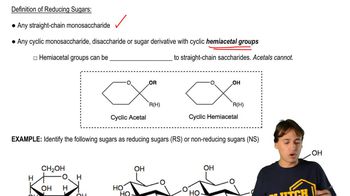
Reducing Sugars