Ch. 20 - The Organic Chemistry of Carbohydrates
Bruice - Organic Chemistry 8th Edition
Bruice8th EditionOrganic ChemistryISBN: 9780135213711Not the one you use?Change textbook
Chapter 21, Problem 34f

What product or products are obtained when D-galactose reacts with each of the following?
f. ethanol + HCl

Verified step by step guidance
1
Identify the functional groups present in d-galactose. D-galactose is an aldose sugar with an aldehyde group (-CHO) at the anomeric carbon and multiple hydroxyl (-OH) groups.
Understand the reaction conditions. Ethanol (C₂H₅OH) in the presence of HCl acts as an acid catalyst, promoting the formation of acetal or hemiacetal derivatives at the anomeric carbon of d-galactose.
Focus on the anomeric carbon. The aldehyde group at the anomeric carbon reacts with ethanol to form a glycosidic bond, resulting in the formation of an ethyl glycoside. This reaction produces two stereoisomers: α- and β-ethyl galactosides, depending on the orientation of the substituent at the anomeric carbon.
Write the general reaction mechanism. The aldehyde group first reacts with ethanol to form a hemiacetal intermediate. In the presence of HCl, the hemiacetal is further converted into a full acetal (glycoside) by replacing the hydroxyl group with an ethoxy group (-OCH₂CH₃).
Conclude the products. The reaction yields a mixture of α-ethyl galactoside and β-ethyl galactoside as the final products, due to the equilibrium between the two stereoisomers.

Verified video answer for a similar problem:

This video solution was recommended by our tutors as helpful for the problem above.
Video duration:
2m
Was this helpful?

Key Concepts

Here are the essential concepts you must grasp in order to answer the question correctly.

Monosaccharide Structure

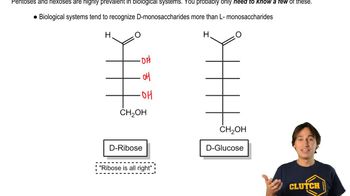
D-galactose is a monosaccharide, specifically an aldohexose, which means it contains six carbon atoms and an aldehyde functional group. Understanding its structure is crucial for predicting how it will react with other compounds, as the configuration of hydroxyl groups can influence reactivity and product formation.
Recommended video:
Guided course
06:06
Monosaccharides - Common Structures

Esterification Reaction

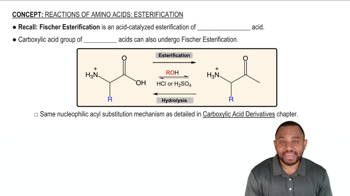
The reaction of d-galactose with ethanol in the presence of HCl typically leads to esterification, where the hydroxyl group of the sugar reacts with the alcohol to form an ester. This process involves the formation of a glycosidic bond, which is essential for understanding how sugars can be modified chemically.
Recommended video:
1:21
Reactions of Amino Acids: Esterification Concept 1

Acid-Catalyzed Reactions

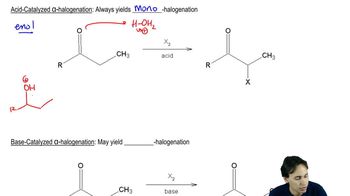
HCl acts as a catalyst in this reaction, facilitating the conversion of d-galactose and ethanol into products. Acid-catalyzed reactions often enhance the reactivity of alcohols and sugars, making it important to recognize how acids can influence the mechanism and outcome of organic reactions.
Recommended video:
Guided course
03:09
Acid Catalyzed