Ch. 20 - The Organic Chemistry of Carbohydrates
Bruice - Organic Chemistry 8th Edition
Bruice8th EditionOrganic ChemistryISBN: 9780135213711Not the one you use?Change textbook
Chapter 21, Problem 36b

Identify the sugar in each description.
b. A sugar that is not D-altrose forms D-altraric acid when it is oxidized with nitric acid.

Verified step by step guidance
1
Step 1: Understand the problem. The question asks us to identify a sugar that, when oxidized with nitric acid, forms D-altraric acid. This involves understanding the oxidation process and the structure of D-altraric acid.
Step 2: Recall the oxidation reaction with nitric acid. When a sugar is treated with nitric acid, both the aldehyde group (or ketone group) and the primary alcohol group are oxidized to carboxylic acids. This reaction converts aldoses or ketoses into dicarboxylic acids.
Step 3: Analyze the structure of D-altraric acid. D-altraric acid is a meso compound derived from D-altrose. It has two carboxylic acid groups at the ends of the molecule and specific stereochemistry at its chiral centers. This stereochemistry is key to identifying the sugar precursor.
Step 4: Determine the sugar precursor. Since the sugar is not D-altrose but forms D-altraric acid upon oxidation, it must be a diastereomer of D-altrose. Diastereomers have the same molecular formula but differ in the configuration of one or more chiral centers.
Step 5: Compare the stereochemistry of D-altrose with its diastereomers. Identify the diastereomer that, upon oxidation, would yield the same stereochemical arrangement as D-altraric acid. This sugar is the answer to the problem.

Verified video answer for a similar problem:

This video solution was recommended by our tutors as helpful for the problem above.
Video duration:
4m
Was this helpful?

Key Concepts

Here are the essential concepts you must grasp in order to answer the question correctly.

D-Altraric Acid Formation

D-Altraric acid is a dicarboxylic acid formed from the oxidation of certain sugars. When sugars are oxidized, their aldehyde or alcohol groups can be converted into carboxylic acids. In this case, the oxidation of a sugar that is not d-altrose leads to the formation of D-altraric acid, indicating specific structural features of the sugar involved.
Recommended video:
Guided course
06:47
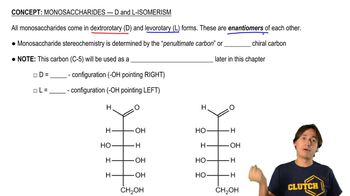
Monosaccharides - D and L Isomerism

Oxidation Reactions in Sugars

Oxidation reactions in organic chemistry involve the loss of electrons or an increase in oxidation state. For sugars, this often means converting hydroxyl groups into carbonyl groups or carboxylic acids. Understanding how different sugars react to oxidizing agents, like nitric acid, is crucial for identifying their structures and derivatives.
Recommended video:
Guided course
08:42
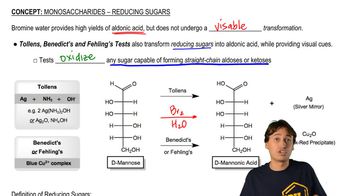
Reducing Sugars

Sugar Classification

Sugars can be classified based on their structure and functional groups, such as aldoses and ketoses. D-altrose is an aldose, which contains an aldehyde group. Recognizing the differences between various sugars, including their stereochemistry and functional groups, is essential for determining which sugar is being described in the context of oxidation reactions.
Recommended video:
Guided course
08:42
Reducing Sugars