Ch. 20 - The Organic Chemistry of Carbohydrates
Bruice - Organic Chemistry 8th Edition
Bruice8th EditionOrganic ChemistryISBN: 9780135213711Not the one you use?Change textbook
Chapter 21, Problem 38a,b

Answer the following questions about the eight aldopentoses:
a. Which are enantiomers?
b. Which are C-2 epimers?

Verified step by step guidance
1
Step 1: Understand the structure of aldopentoses. Aldopentoses are monosaccharides with five carbon atoms, including an aldehyde group at the C-1 position. The remaining carbons have hydroxyl groups attached, and the stereochemistry at the chiral centers determines the specific aldopentose.
Step 2: Define enantiomers. Enantiomers are pairs of molecules that are non-superimposable mirror images of each other. For aldopentoses, enantiomers will have opposite configurations at all chiral centers.
Step 3: Identify the eight aldopentoses. The eight aldopentoses include D-ribose, D-arabinose, D-xylose, D-lyxose, and their corresponding L-forms (L-ribose, L-arabinose, L-xylose, L-lyxose). Enantiomers are formed by pairing each D-form with its corresponding L-form.
Step 4: Define epimers. Epimers are stereoisomers that differ in configuration at only one chiral center. For C-2 epimers, the difference occurs specifically at the second carbon atom. Compare the stereochemistry at C-2 for each aldopentose to identify pairs that differ only at this position.
Step 5: Analyze the aldopentoses to determine C-2 epimers. For example, D-ribose and D-arabinose differ only at the C-2 position, making them C-2 epimers. Similarly, L-ribose and L-arabinose are C-2 epimers. Repeat this analysis for other pairs of aldopentoses to identify additional C-2 epimers.

Verified video answer for a similar problem:

This video solution was recommended by our tutors as helpful for the problem above.
Video duration:
6m
Was this helpful?

Key Concepts

Here are the essential concepts you must grasp in order to answer the question correctly.

Aldopentoses

Aldopentoses are a class of monosaccharides that contain five carbon atoms and an aldehyde functional group. They are important in biochemistry and can exist in various stereoisomeric forms. The eight aldopentoses include ribose, arabinose, xylose, and lyxose, each differing in the arrangement of hydroxyl groups around the carbon skeleton.
Recommended video:
Guided course
02:42
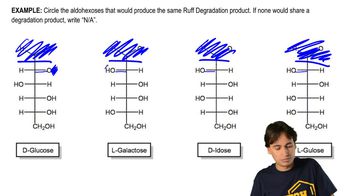
Which aldohexoses produce the same Ruff Degradation product

Enantiomers

Enantiomers are a type of stereoisomer that are non-superimposable mirror images of each other. They typically arise in molecules that have one or more chiral centers, leading to two distinct configurations. In the context of aldopentoses, identifying enantiomers involves recognizing pairs of sugars that differ at all chiral centers.
Recommended video:
Guided course
03:23
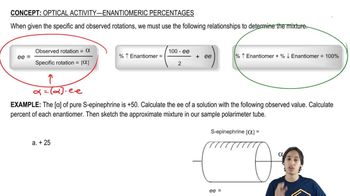
How to solve for the percentage of each enantiomer.

Epimers

Epimers are a specific type of diastereomer that differ in configuration at only one chiral center. In aldopentoses, C-2 epimers refer to sugars that have different configurations at the second carbon atom while remaining identical at all other chiral centers. Understanding epimerism is crucial for distinguishing between closely related sugars and their biological roles.
Recommended video:
Guided course
03:42
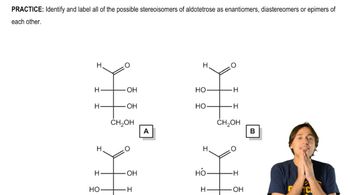
Identifying Types of Stereoisomers