Ch. 20 - Carboxylic Acids
Wade - Organic Chemistry 9th Edition
Wade9th EditionOrganic ChemistryISBN: 9780135213728Not the one you use?Change textbook
Chapter 20, Problem 21a1

Show how the following ketones might be synthesized from the indicated acids, using any necessary reagents.
(a) propiophenone from propionic acid (using alkylation of the acid)

Verified step by step guidance
1
Start with the given acid, propionic acid (CH₃CH₂COOH). The goal is to convert this carboxylic acid into a ketone, propiophenone (C₆H₅COCH₂CH₃).
First, convert the carboxylic acid into an acid chloride. This can be achieved by reacting propionic acid with thionyl chloride (SOCl₂) or oxalyl chloride. The reaction produces propionyl chloride (CH₃CH₂COCl) and releases HCl and SO₂ as byproducts.
Next, perform a Friedel-Crafts acylation reaction. React the propionyl chloride with benzene (C₆H₆) in the presence of a Lewis acid catalyst, such as aluminum chloride (AlCl₃). This step introduces the acyl group (CH₃CH₂CO-) onto the benzene ring, forming propiophenone.
After the reaction, perform a workup to neutralize the reaction mixture and isolate the product. This typically involves quenching the reaction with water or dilute acid to remove the catalyst and any remaining reagents.
Finally, purify the product, propiophenone, using techniques such as distillation or recrystallization to ensure it is free of impurities.

Verified video answer for a similar problem:

This video solution was recommended by our tutors as helpful for the problem above.
Video duration:
1m
Was this helpful?

Key Concepts

Here are the essential concepts you must grasp in order to answer the question correctly.

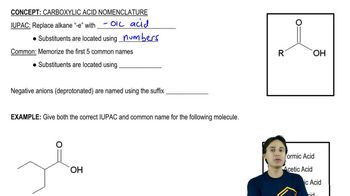
Alkylation of Carboxylic Acids

Alkylation of carboxylic acids involves the introduction of an alkyl group to the acid, typically through a reaction with an alkyl halide in the presence of a base. This process allows for the formation of a new carbon-carbon bond, which is essential for synthesizing ketones from acids. In the case of propionic acid, the alkylation can lead to the formation of a propanoyl group, which is a precursor to propiophenone.
Recommended video:
Guided course
04:20
Carboxylic Acids Nomenclature

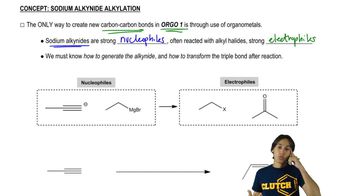
Reagents for Alkylation

Common reagents used in the alkylation of carboxylic acids include alkyl halides and strong bases such as sodium hydride or lithium diisopropylamide (LDA). The base deprotonates the carboxylic acid, generating a carbanion that can then attack the alkyl halide, resulting in the formation of a new carbon chain. Choosing the right alkyl halide is crucial for achieving the desired ketone structure.
Recommended video:
Guided course
03:19
Sodium Alkynide Alkylation

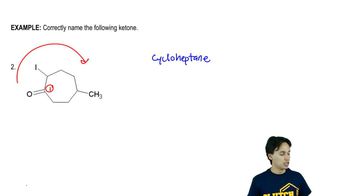
Formation of Ketones

Ketones are organic compounds characterized by a carbonyl group (C=O) flanked by two carbon atoms. In the synthesis of propiophenone from propionic acid, the alkylation process introduces an additional carbon chain, leading to the formation of the ketone. Understanding the structure and reactivity of ketones is vital for predicting their behavior in further reactions and their applications in organic synthesis.
Recommended video:
Guided course
02:27
Name the ketone