Ch. 20 - Carboxylic Acids
Wade - Organic Chemistry 9th Edition
Wade9th EditionOrganic ChemistryISBN: 9780135213728Not the one you use?Change textbook
Chapter 20, Problem 22

Propose a mechanism for the reaction of benzoic acid with oxalyl chloride. This mechanism begins like the thionyl chloride reaction, to give a reactive mixed anhydride. Nucleophilic acyl substitution by chloride ion gives a tetrahedral intermediate that eliminates a leaving group, which then fragments into carbon dioxide, carbon monoxide, and chloride ion.

Verified step by step guidance
1
The reaction begins with the activation of benzoic acid by oxalyl chloride. The carbonyl carbon of oxalyl chloride acts as an electrophile and is attacked by the lone pair of electrons on the oxygen atom of the benzoic acid's hydroxyl group. This forms a reactive mixed anhydride intermediate.
The mixed anhydride intermediate undergoes nucleophilic acyl substitution. A chloride ion (Cl⁻) from oxalyl chloride attacks the carbonyl carbon of the benzoic acid moiety in the mixed anhydride, forming a tetrahedral intermediate.
The tetrahedral intermediate collapses, eliminating a leaving group. This leaving group is the portion of the oxalyl chloride that was attached to the benzoic acid. The elimination restores the carbonyl group on the benzoic acid derivative.
The leaving group that was eliminated fragments further. It breaks down into carbon dioxide (CO₂), carbon monoxide (CO), and a chloride ion (Cl⁻). This fragmentation is driven by the stability of the gaseous products (CO₂ and CO).
The final product of the reaction is benzoyl chloride, which is formed after the elimination and fragmentation steps. The reaction is complete with the release of CO₂, CO, and Cl⁻ as byproducts.

Verified video answer for a similar problem:

This video solution was recommended by our tutors as helpful for the problem above.
Video duration:
12m
Was this helpful?

Key Concepts

Here are the essential concepts you must grasp in order to answer the question correctly.

Nucleophilic Acyl Substitution

Nucleophilic acyl substitution is a fundamental reaction in organic chemistry where a nucleophile attacks the carbonyl carbon of an acyl compound, leading to the substitution of the acyl group. In this process, a tetrahedral intermediate is formed, which can then collapse to regenerate the carbonyl and release a leaving group. This mechanism is crucial for understanding how benzoic acid reacts with oxalyl chloride, as it involves the formation of a reactive mixed anhydride.
Recommended video:
Guided course
01:47
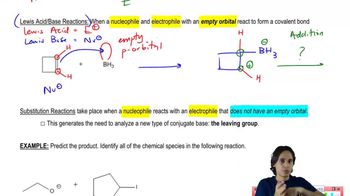
Nucleophiles and Electrophiles can react in Substitution Reactions.

Tetrahedral Intermediate

A tetrahedral intermediate is a transient species formed during nucleophilic acyl substitution, characterized by a carbon atom bonded to four substituents. This intermediate arises when a nucleophile attacks the carbonyl carbon, resulting in a temporary change in hybridization from sp2 to sp3. Understanding this intermediate is essential for grasping the reaction mechanism, as its stability and subsequent breakdown dictate the reaction's pathway and products.
Recommended video:
Guided course
04:31
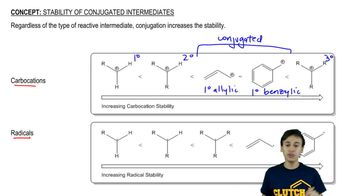
Stability of Conjugated Intermediates

Fragmentation Reaction

Fragmentation reactions involve the breakdown of a larger molecule into smaller fragments, often resulting in the release of small gaseous products. In the context of the reaction between benzoic acid and oxalyl chloride, the tetrahedral intermediate can fragment to yield carbon dioxide, carbon monoxide, and chloride ion. This step is significant as it illustrates how the reaction proceeds to completion, transforming the initial reactants into stable gaseous products.
Recommended video:
Guided course
12:08
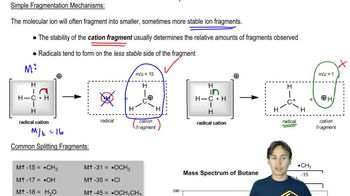
Simple Fragmentation Mechanisms