Ch. 20 - Carboxylic Acids
Wade - Organic Chemistry 9th Edition
Wade9th EditionOrganic ChemistryISBN: 9780135213728Not the one you use?Change textbook
Chapter 20, Problem 20b

Draw the following sugars using Haworth projections:
b. α-D-tagatopyranose

Verified step by step guidance
1
Understand the problem: You are tasked with drawing the Haworth projection of α-D-tagatopyranose. This involves converting the sugar from its Fischer projection to its cyclic (Haworth) form, specifically in the pyranose (six-membered ring) form.
Step 1: Identify the structure of D-tagatose in its Fischer projection. D-tagatose is a ketohexose, meaning it has six carbons and a ketone group at the second carbon. The hydroxyl groups (-OH) on carbons 3, 4, and 5 are arranged as follows: left, right, and right, respectively, in the Fischer projection.
Step 2: Cyclize the sugar into its pyranose form. The hydroxyl group on carbon 5 attacks the carbonyl carbon (C2, the ketone group) to form a six-membered ring. This creates a new chiral center at C2, which determines the α or β anomer. For the α-anomer, the newly formed hydroxyl group at C2 will point down in the Haworth projection.
Step 3: Draw the six-membered ring (pyranose) structure. Place oxygen as one of the ring atoms, and arrange the remaining carbons (C1 through C6) around the ring. Ensure that the substituents (hydroxyl groups and hydrogens) are placed correctly based on the Fischer projection. For D-sugars, the CH2OH group at C5 points up in the Haworth projection.
Step 4: Finalize the Haworth projection for α-D-tagatopyranose. Ensure that the hydroxyl group at C2 (the anomeric carbon) points down (α-anomer), and the other substituents are placed according to the stereochemistry of the original Fischer projection. Double-check the orientation of all groups to ensure accuracy.

Verified video answer for a similar problem:

This video solution was recommended by our tutors as helpful for the problem above.
Video duration:
5m
Was this helpful?

Key Concepts

Here are the essential concepts you must grasp in order to answer the question correctly.

Haworth Projections

Haworth projections are a way to represent the cyclic forms of sugars, particularly monosaccharides. They depict the sugar in a cyclic structure, showing the orientation of the hydroxyl groups and the anomeric carbon. This representation helps visualize the stereochemistry of the sugar, which is crucial for understanding its reactivity and interactions.
Recommended video:
Guided course
04:03
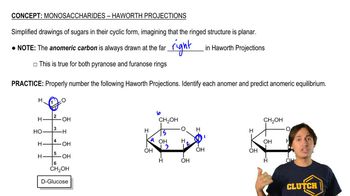
Monosaccharides - Haworth Projections

Anomeric Carbon

The anomeric carbon is the carbon atom in a sugar that was the carbonyl carbon in its open-chain form. In cyclic sugars, it becomes a new stereocenter, leading to two possible configurations: alpha (α) and beta (β). The configuration of the anomeric carbon significantly influences the sugar's properties and its role in biological systems.
Recommended video:
Guided course
02:12
Carbonation of Grignard Reagents

D- and L- Configuration

The D- and L- configuration of sugars refers to the orientation of the hydroxyl group on the penultimate carbon (the second-to-last carbon) in the Fischer projection. D-sugars have the hydroxyl group on the right, while L-sugars have it on the left. This classification is essential for distinguishing between different sugar isomers and understanding their biological functions.
Recommended video:
Guided course
05:09
Representations of L-Configuration