Ch. 28 - Pericyclic Reactions
Bruice - Organic Chemistry 8th Edition
Bruice8th EditionOrganic ChemistryISBN: 9780135213711Not the one you use?Change textbook
Chapter 25, Problem 13b

If the terminal sp2 carbon of the substituent attached to the benzene ring is labeled with 14C, where will the label be in the product?

Verified step by step guidance
1
Identify the structure of the substituent attached to the benzene ring and confirm that it contains a terminal sp² carbon. The sp² hybridization indicates that the carbon is part of a double bond or an aromatic system.
Understand the reaction mechanism that the benzene ring and its substituent undergo. For example, if the reaction involves electrophilic aromatic substitution, determine how the substituent directs the incoming group (ortho, meta, or para).
Trace the fate of the labeled 14C atom through the reaction mechanism. Consider whether the reaction involves rearrangement, migration, or retention of the labeled carbon in the product.
Analyze the product structure to determine the final position of the 14C label. Pay attention to whether the labeled carbon remains part of the substituent or becomes incorporated into the benzene ring or another part of the molecule.
Verify the position of the 14C label in the product by ensuring that the reaction mechanism and product structure are consistent with the labeling and the chemical transformations involved.

Verified video answer for a similar problem:

This video solution was recommended by our tutors as helpful for the problem above.
Was this helpful?

Key Concepts

Here are the essential concepts you must grasp in order to answer the question correctly.

Benzene Ring Structure

The benzene ring is a six-carbon cyclic structure with alternating double bonds, known for its stability due to resonance. Each carbon in the ring is sp2 hybridized, allowing for the formation of sigma bonds with adjacent carbons and a delocalized pi electron system. Understanding this structure is crucial for predicting how substituents will interact with the ring during chemical reactions.
Recommended video:
Guided course
09:04
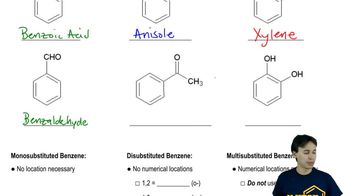
Benzene Nomenclature

Substituent Effects on Reactivity

Substituents on a benzene ring can influence the reactivity and orientation of electrophilic aromatic substitution reactions. Electron-donating groups (EDGs) activate the ring and direct incoming electrophiles to ortho and para positions, while electron-withdrawing groups (EWGs) deactivate the ring and direct electrophiles to the meta position. Recognizing these effects is essential for determining the fate of the labeled carbon in the product.
Recommended video:
3:26
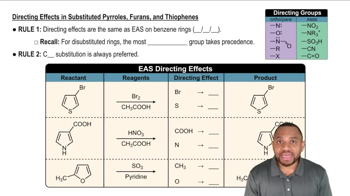
Directing Effects in Substituted Pyrroles, Furans, and Thiophenes Concept 2

Isotope Labeling in Organic Chemistry

Isotope labeling involves incorporating a stable or radioactive isotope, such as 14C, into a molecule to trace its behavior in chemical reactions. In this context, the position of the 14C label in the final product can provide insights into the reaction mechanism and the movement of atoms during the reaction. Understanding how isotopes behave in organic reactions is key to predicting the location of the label in the product.
Recommended video:
Guided course
00:56
What is an organic molecule?