Ch. 10 - Reactions of Alcohols, Ethers, Epoxides, Amines, and Sulfur-Containing Compounds
Bruice - Organic Chemistry 8th Edition
Bruice8th EditionOrganic ChemistryISBN: 9780135213711Not the one you use?Change textbook
Chapter 11, Problem 63h

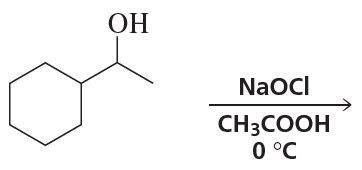
What is the major product(s) of each of the following reactions?
h. Chemical reaction diagram showing an alcohol reacting with sodium hypochlorite in acetic acid at 0°C.

Verified step by step guidance
1
Step 1: Identify the type of reaction. The reagents NaOCl (sodium hypochlorite) in CH3COOH (acetic acid) at 0°C indicate an oxidation reaction. Specifically, this is a hypochlorite oxidation, which is commonly used to convert secondary alcohols into ketones.
Step 2: Analyze the structure of the starting material. The molecule contains a secondary alcohol group (-OH) attached to a cyclopentane ring with an isopropyl substituent.
Step 3: Predict the site of oxidation. Secondary alcohols are oxidized to ketones. The hydroxyl group (-OH) will lose two hydrogen atoms: one from the oxygen and one from the carbon it is attached to, forming a carbonyl group (C=O).
Step 4: Consider the stereochemistry and regioselectivity. Since the reaction involves oxidation of the secondary alcohol, the product will retain the same carbon skeleton and substituents as the starting material, but the hydroxyl group will be replaced by a ketone group.
Step 5: Write the structure of the major product. The major product will be a cyclopentane ring with an isopropyl substituent and a ketone group at the position where the secondary alcohol was originally located.

Verified video answer for a similar problem:

This video solution was recommended by our tutors as helpful for the problem above.
Video duration:
48s
Was this helpful?

Key Concepts

Here are the essential concepts you must grasp in order to answer the question correctly.

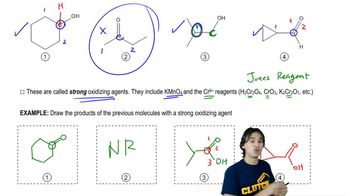
Oxidation of Alcohols

Alcohols can undergo oxidation reactions, where they are converted into carbonyl compounds such as aldehydes or ketones. The oxidizing agent, in this case, sodium hypochlorite (NaOCl), facilitates this transformation. The reaction conditions, including temperature and solvent, can influence the product formed, with primary alcohols typically yielding aldehydes and secondary alcohols yielding ketones.
Recommended video:
Guided course
05:53
Strong oxidizing agents

Mechanism of Reaction

Understanding the mechanism of the oxidation reaction is crucial for predicting the major product. The reaction typically involves the formation of a chlorinated intermediate, followed by the loss of a water molecule, leading to the formation of the carbonyl compound. The specific pathway taken can depend on the structure of the alcohol and the reaction conditions.
Recommended video:
Guided course
02:16
Heck Reaction Mechanism

Role of Solvent

The choice of solvent can significantly affect the outcome of a chemical reaction. In this case, acetic acid (CH3COOH) serves as a solvent that can stabilize intermediates and influence the reactivity of the oxidizing agent. The solvent can also participate in the reaction, potentially leading to different products based on its properties, such as polarity and acidity.
Recommended video:
Guided course
01:16
Identification of polarity in solvents