Ch.4 - The Study of Chemical Reactions
Wade - Organic Chemistry 9th Edition
Wade9th EditionOrganic ChemistryISBN: 9780135213728Not the one you use?Change textbook
Chapter 4, Problem 16a,b

The bromination of methane proceeds through the following steps:

a. Draw a complete reaction-energy diagram for this reaction.
b. Label the rate-limiting step.

Verified step by step guidance
1
Step 1: Understand the reaction mechanism. The bromination of methane involves a chain reaction mechanism with three main steps: initiation, propagation, and termination. The provided data includes the enthalpy change (ΔH°) and activation energy (Ea) for each step. These values will help in constructing the reaction-energy diagram.
Step 2: Plot the reaction-energy diagram. On the y-axis, represent the energy levels, and on the x-axis, represent the reaction progress. Start with the energy of the reactants (Br2 and CH4) and proceed through the energy changes for each step. Use the ΔH° values to determine whether each step is exothermic (energy released) or endothermic (energy absorbed).
Step 3: Represent the activation energy (Ea) for each step. For each step in the mechanism, draw a peak on the energy diagram to represent the activation energy. The height of the peak corresponds to the Ea value provided for that step. For example, the initiation step has an Ea of 190 kJ (45 kcal), so its peak will be relatively high.
Step 4: Label the rate-limiting step. The rate-limiting step is the step with the highest activation energy (Ea). In this case, compare the Ea values for all steps and identify the step with the largest Ea. Label this step clearly on the diagram.
Step 5: Add labels for intermediates and products. After each peak, draw a valley to represent the intermediate species (e.g., Br•, CH3•). Finally, show the energy level of the products (CH3Br and HBr) relative to the reactants. Use the ΔH° values to position the products lower or higher than the reactants, depending on whether the overall reaction is exothermic or endothermic.

Verified video answer for a similar problem:

This video solution was recommended by our tutors as helpful for the problem above.
Video duration:
11m
Was this helpful?

Key Concepts

Here are the essential concepts you must grasp in order to answer the question correctly.

Reaction Energy Diagram

A reaction energy diagram visually represents the energy changes during a chemical reaction. It typically plots the potential energy of reactants and products against the progress of the reaction. Key features include the activation energy (Ea) required for the reaction to proceed and the overall change in enthalpy (ΔH°). Understanding this diagram is crucial for identifying the energy barriers and the stability of intermediates.
Recommended video:
Guided course
06:07
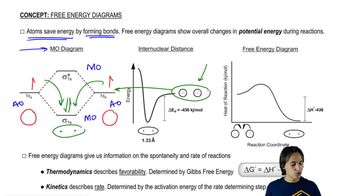
Introduction to free energy diagrams.

Activation Energy (Ea)

Activation energy is the minimum energy required for a chemical reaction to occur. It represents the energy barrier that reactants must overcome to form products. In the context of the bromination of methane, the Ea values provided indicate how much energy is needed for each step of the reaction. Identifying the step with the highest Ea helps determine the rate-limiting step, which dictates the overall reaction rate.
Recommended video:
3:22
EAS Reactions of Pyridine Concept 3

Rate-Limiting Step

The rate-limiting step in a reaction mechanism is the slowest step that determines the overall rate of the reaction. It has the highest activation energy compared to other steps in the mechanism. In the bromination of methane, identifying this step is essential for understanding how the reaction proceeds and how factors like temperature and concentration can affect the reaction rate.
Recommended video: