
Ch.4 - The Study of Chemical Reactions
Wade - Organic Chemistry 9th Edition
Wade9th EditionOrganic ChemistryISBN: 9780135213728Not the one you use?Change textbook
Chapter 4, Problem 15a

Draw a reaction-energy diagram for the following reaction:
•CH3 + Cl2 → CH3Cl + Cl•
The activation energy is 4 kJ/mol (1 kcal/mol), and the overall ΔH° for the reaction is –110 kJ/mol (–27 kcal/mol).

Verified step by step guidance
1
Step 1: Understand the reaction mechanism. This reaction involves a radical substitution mechanism where a methyl radical (•CH3) reacts with chlorine (Cl2) to form methyl chloride (CH3Cl) and a chlorine radical (Cl•). The reaction proceeds through an intermediate state.
Step 2: Identify the energy components. The reaction-energy diagram will include the energy of the reactants (•CH3 and Cl2), the energy of the transition state, and the energy of the products (CH3Cl and Cl•). The transition state represents the highest energy point in the reaction pathway.
Step 3: Label the axes of the diagram. The x-axis represents the reaction coordinate, which tracks the progress of the reaction from reactants to products. The y-axis represents the potential energy of the system.
Step 4: Draw the energy profile. Start by plotting the energy of the reactants (•CH3 and Cl2) at a certain level. Then, draw a peak to represent the transition state, which is higher in energy than the reactants. Finally, plot the energy of the products (CH3Cl and Cl•), which should be lower than the reactants if the reaction is exothermic.
Step 5: Annotate the diagram. Label the reactants, transition state, and products on the diagram. Indicate the activation energy (the energy difference between the reactants and the transition state) and the overall energy change (the difference between the reactants and products).

Verified video answer for a similar problem:

This video solution was recommended by our tutors as helpful for the problem above.
Video duration:
2m
Was this helpful?

Key Concepts

Here are the essential concepts you must grasp in order to answer the question correctly.

Reaction Energy Diagram

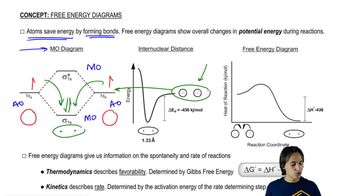
A reaction energy diagram visually represents the energy changes during a chemical reaction. It typically includes the energy of reactants, products, and the transition state, illustrating the activation energy required for the reaction to proceed. The diagram helps in understanding the thermodynamics and kinetics of the reaction, showing whether it is exothermic or endothermic.
Recommended video:
Guided course
06:07
Introduction to free energy diagrams.

Mechanism of Halogenation

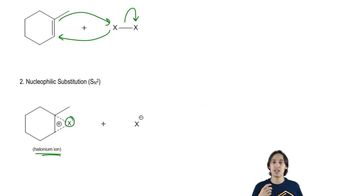
The halogenation of alkanes, such as the reaction of CH3 with Cl2, involves a free radical mechanism. This process includes initiation (formation of radicals), propagation (reaction of radicals with stable molecules), and termination (combination of radicals). Understanding this mechanism is crucial for predicting the products and the energy changes involved in the reaction.
Recommended video:
Guided course
03:45
Halogenation Mechanism

Activation Energy

Activation energy is the minimum energy required for a chemical reaction to occur. It represents the energy barrier that reactants must overcome to form products. In the context of the reaction between CH3 and Cl2, the activation energy is critical for determining the rate of the reaction and can be influenced by factors such as temperature and the presence of catalysts.
Recommended video:
Guided course
06:07
Introduction to free energy diagrams.