Ch.4 - The Study of Chemical Reactions
Wade - Organic Chemistry 9th Edition
Wade9th EditionOrganic ChemistryISBN: 9780135213728Not the one you use?Change textbook
Chapter 4, Problem 15b,c

•CH3 + Cl2 → CH3Cl + Cl•
The activation energy is 4 kJ/mol (1 kcal/mol), and the overall ΔH° for the reaction is –110 kJ/mol (–27 kcal/mol).
b. Give the equation for the reverse reaction.
c. What is the activation energy for the reverse reaction?

Verified step by step guidance
1
Step 1: Write the equation for the reverse reaction. The reverse reaction is simply the backward process of the given reaction. Start with the products (CH3Cl and Cl•) as the reactants, and the reactants (•CH3 and Cl2) as the products. The reverse reaction equation is: CH3Cl + Cl• → •CH3 + Cl2.
Step 2: Understand the relationship between the activation energy of the forward and reverse reactions. The activation energy for the reverse reaction (Ea_reverse) can be calculated using the equation: Ea_reverse = Ea_forward + ΔH° (in the reverse direction, ΔH° changes sign).
Step 3: Substitute the given values into the equation. The activation energy for the forward reaction (Ea_forward) is 4 kJ/mol, and the overall ΔH° for the forward reaction is -110 kJ/mol. For the reverse reaction, ΔH° becomes +110 kJ/mol.
Step 4: Add the values to calculate Ea_reverse. Using the equation Ea_reverse = Ea_forward + ΔH°, substitute Ea_forward = 4 kJ/mol and ΔH° = +110 kJ/mol. Perform the addition to determine the activation energy for the reverse reaction.
Step 5: Conclude that the activation energy for the reverse reaction is the sum of the forward activation energy and the reverse ΔH°. This value represents the energy barrier that must be overcome for the reverse reaction to proceed.

Verified video answer for a similar problem:

This video solution was recommended by our tutors as helpful for the problem above.
Video duration:
6m
Was this helpful?

Key Concepts

Here are the essential concepts you must grasp in order to answer the question correctly.

Activation Energy

Activation energy is the minimum energy required for a chemical reaction to occur. It represents the energy barrier that reactants must overcome to transform into products. In this context, the activation energy for the forward reaction is given as 4 kJ/mol, indicating how much energy is needed to initiate the reaction.
Recommended video:
Guided course
06:07
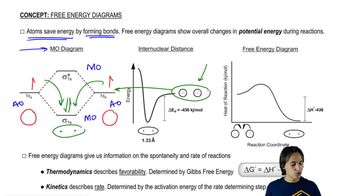
Introduction to free energy diagrams.

Enthalpy Change (ΔH°)

Enthalpy change (ΔH°) is the difference in total energy between reactants and products in a chemical reaction. A negative ΔH° indicates that the reaction is exothermic, meaning it releases energy. In this case, the overall ΔH° of -110 kJ/mol suggests that the reaction releases a significant amount of energy as it proceeds from reactants to products.
Recommended video:
Guided course
04:38
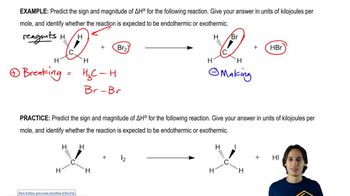
Calculating Enthalpies

Reverse Reaction

The reverse reaction is the process in which products are converted back into reactants. For the given reaction, the reverse equation would be CH3Cl + Cl• → CH3 + Cl2. The activation energy for the reverse reaction can be calculated by adding the activation energy of the forward reaction to the absolute value of the enthalpy change, reflecting the energy needed to revert to the original state.
Recommended video:
Guided course
11:50
EAS Reactions Overview