Ch. 3 - Alkanes and Cycloalkanes: Properties and Conformational Analysis
Mullins - Organic Chemistry: A Learner Centered Approach 1st Edition
Mullins1st EditionOrganic Chemistry: A Learner Centered ApproachISBN: 9780137566471Not the one you use?Change textbook
Chapter 2, Problem 48e

For each molecular formula, represent all constitutional isomers using line-angle drawings.
(e) C6H14

Verified step by step guidance
1
Understand the problem: The molecular formula C₆H₁₄ represents an alkane (a saturated hydrocarbon with only single bonds). Constitutional isomers are compounds with the same molecular formula but different connectivity of atoms. We need to draw all possible unique structures for C₆H₁₄ using line-angle drawings.
Step 1: Start with the straight-chain alkane (n-hexane). This is the simplest structure where all six carbon atoms are connected in a single continuous chain. Draw this structure using a line-angle representation.
Step 2: Create branched isomers by shortening the main chain and adding methyl (CH₃) or ethyl (C₂H₅) groups as substituents. For example, create a 5-carbon chain (pentane) and attach a methyl group to one of the carbons. Ensure that each structure is unique and follows the rules of valency (each carbon should have four bonds).
Step 3: Continue creating additional branched isomers by further shortening the main chain to 4 carbons (butane) and adding substituents in different positions. For example, attach two methyl groups to different carbons or the same carbon in the chain. Again, ensure that each structure is unique.
Step 4: Verify that all possible isomers have been drawn. Check for duplicates (structures that are identical when rotated or flipped) and confirm that each structure adheres to the molecular formula C₆H₁₄. You should end up with a total of 5 constitutional isomers for C₆H₁₄.

Verified video answer for a similar problem:

This video solution was recommended by our tutors as helpful for the problem above.
Was this helpful?

Key Concepts

Here are the essential concepts you must grasp in order to answer the question correctly.

Constitutional Isomers

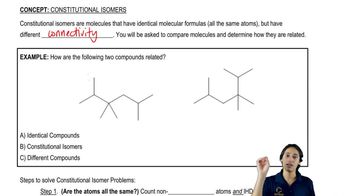
Constitutional isomers are compounds that have the same molecular formula but differ in the connectivity of their atoms. This means that the arrangement of atoms in the molecule varies, leading to different structural forms. Understanding constitutional isomers is crucial for recognizing how variations in structure can affect the properties and reactivity of organic compounds.
Recommended video:
Guided course
01:10
What is a constitutional isomer?

Line-Angle Drawings

Line-angle drawings, also known as skeletal structures, are a shorthand way of representing organic molecules. In these drawings, carbon atoms are represented by the ends and intersections of lines, while hydrogen atoms are often omitted for simplicity. This method allows chemists to visualize complex structures quickly and is essential for illustrating the various constitutional isomers of a given molecular formula.
Recommended video:
Guided course
02:46
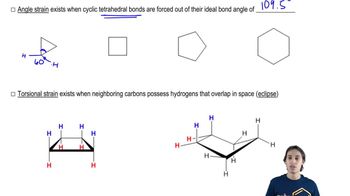
What is angle strain?

Molecular Formula

A molecular formula indicates the number and types of atoms in a molecule, represented by chemical symbols and subscripts. For example, C₆H₁₄ indicates a molecule with six carbon atoms and fourteen hydrogen atoms. Understanding molecular formulas is fundamental in organic chemistry, as they provide the basis for identifying possible isomers and their structural variations.
Recommended video:
Guided course
02:17
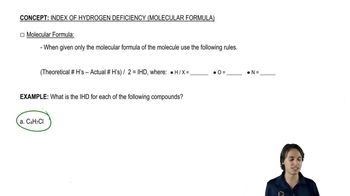
How to use IHD with molecular formula.