Ch. 3 - Alkanes and Cycloalkanes: Properties and Conformational Analysis
Mullins - Organic Chemistry: A Learner Centered Approach 1st Edition
Mullins1st EditionOrganic Chemistry: A Learner Centered ApproachISBN: 9780137566471Not the one you use?Change textbook
Chapter 2, Problem 47e

Represent each of the following condensed structural formulas using a line-angle drawing.
(e) (CH3)2CHCH2CH2CH2CH2CHO

Verified step by step guidance
1
Step 1: Identify the main chain in the condensed structural formula. The main chain is the longest continuous chain of carbon atoms. In this case, the main chain consists of 7 carbon atoms, ending with an aldehyde group (-CHO).
Step 2: Recognize the substituents attached to the main chain. Here, there is a (CH3)2CH group (an isopropyl group) attached to the second carbon of the main chain.
Step 3: Begin drawing the line-angle structure. Start with a zigzag line representing the main chain of 7 carbons. Each vertex represents a carbon atom, and the aldehyde group (-CHO) is drawn explicitly at the end of the chain.
Step 4: Add the substituents to the line-angle structure. Attach the isopropyl group ((CH3)2CH) to the second carbon of the main chain. Represent the isopropyl group as a branch with two methyl groups attached to a single carbon.
Step 5: Double-check the structure to ensure all carbons and hydrogens are accounted for, and the aldehyde group is correctly placed at the terminal position. Verify that the structure matches the condensed formula provided.

Verified video answer for a similar problem:

This video solution was recommended by our tutors as helpful for the problem above.
Video duration:
1m
Was this helpful?

Key Concepts

Here are the essential concepts you must grasp in order to answer the question correctly.

Condensed Structural Formulas

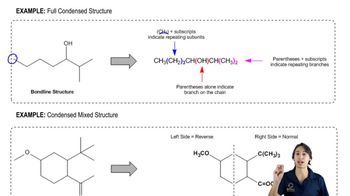
Condensed structural formulas provide a simplified representation of a molecule, showing the arrangement of atoms and their connectivity without depicting all the bonds explicitly. In these formulas, groups of atoms are often grouped together, such as (CH3)2, indicating branching or functional groups. Understanding how to interpret these formulas is essential for translating them into line-angle drawings.
Recommended video:
Guided course
06:06
How to interpret condensed structures.

Line-Angle Drawings

Line-angle drawings, also known as skeletal structures, are a shorthand way of representing organic molecules. In these drawings, vertices represent carbon atoms, and lines represent bonds between them. Hydrogen atoms attached to carbons are usually omitted for simplicity. Mastery of this drawing technique is crucial for visualizing molecular structures quickly and efficiently.
Recommended video:
Guided course
02:46
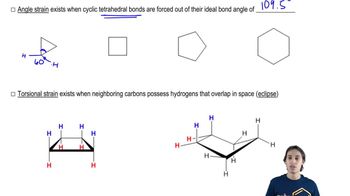
What is angle strain?

Functional Groups

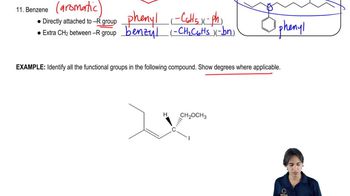
Functional groups are specific groups of atoms within molecules that are responsible for the characteristic chemical reactions of those molecules. In the given formula, the presence of the aldehyde group (CHO) indicates that the molecule has specific reactivity and properties. Recognizing functional groups is vital for understanding the behavior and classification of organic compounds.
Recommended video:
Guided course
02:36
Identifying Functional Groups