Ch. 3 - Alkanes and Cycloalkanes: Properties and Conformational Analysis
Mullins - Organic Chemistry: A Learner Centered Approach 1st Edition
Mullins1st EditionOrganic Chemistry: A Learner Centered ApproachISBN: 9780137566471Not the one you use?Change textbook
Chapter 2, Problem 49c

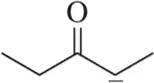
Draw in all missing lone pairs for the following molecules.
(c) Chemical structure of a molecule with an oxygen atom and a double bond, showing missing lone pairs.

Verified step by step guidance
1
Step 1: Identify the molecule shown in the image. The structure represents a ketone functional group, specifically 2-propanone (acetone). The central carbon is double-bonded to an oxygen atom and single-bonded to two methyl groups.
Step 2: Recall that oxygen typically has six valence electrons. In this structure, two of these electrons are involved in the double bond with carbon, leaving four electrons to form lone pairs.
Step 3: Add two lone pairs to the oxygen atom. These lone pairs should be placed symmetrically around the oxygen atom to reflect its tetrahedral electron geometry.
Step 4: Verify that the central carbon atom has a complete octet. The carbon is bonded to two methyl groups and the oxygen atom via a double bond, satisfying the octet rule.
Step 5: Confirm that all other atoms in the molecule (hydrogens and carbons) have the correct number of bonds and no lone pairs are needed for them. Hydrogen atoms are always single-bonded, and the methyl groups are fully saturated.

Verified video answer for a similar problem:

This video solution was recommended by our tutors as helpful for the problem above.
Video duration:
4m
Was this helpful?

Key Concepts

Here are the essential concepts you must grasp in order to answer the question correctly.

Lone Pairs

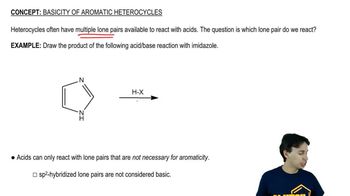
Lone pairs are pairs of valence electrons that are not involved in bonding and are localized on a single atom. In organic chemistry, recognizing lone pairs is crucial for understanding molecular geometry, reactivity, and the overall electronic structure of molecules. They can influence the polarity and hydrogen bonding capabilities of a compound.
Recommended video:
Guided course
02:04
Heterocycles - Which lone pairs react?

Lewis Structures

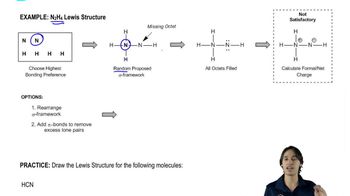
Lewis structures are diagrams that represent the bonding between atoms in a molecule and the lone pairs of electrons that may exist. They provide a visual representation of the arrangement of electrons, helping to predict molecular shape and reactivity. Drawing Lewis structures accurately is essential for identifying missing lone pairs in a given molecule.
Recommended video:
Guided course
04:12
Drawing the Lewis Structure for N2H4.

Valence Shell Electron Pair Repulsion (VSEPR) Theory

VSEPR theory is a model used to predict the geometry of individual molecules based on the repulsion between electron pairs in the valence shell of the central atom. According to this theory, electron pairs, including lone pairs, will arrange themselves to minimize repulsion, which is key to understanding the three-dimensional shape of molecules and the placement of lone pairs.
Recommended video:
Guided course
03:40
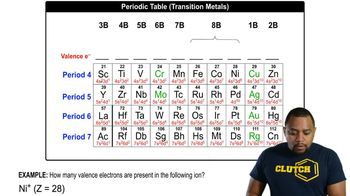
Valence Electrons of Transition Metals