Ch. 15 - Reactions of Carboxylic Acids and Carboxylic Acid Derivatives
Bruice - Organic Chemistry 8th Edition
Bruice8th EditionOrganic ChemistryISBN: 9780135213711Not the one you use?Change textbook
Chapter 16, Problem 69c,d

Phosgene (COCl2) was used as a poison gas in World War I. What product would be formed from the reaction of phosgene with each of the ­following reagents?
c. excess propylamine
d. excess water

Verified step by step guidance
1
Step 1: Understand the structure and reactivity of phosgene (COCl₂). Phosgene is a reactive compound with a carbonyl group (C=O) bonded to two chlorine atoms. It is an electrophile and reacts readily with nucleophiles such as amines and water.
Step 2: Analyze the reaction with excess propylamine (C₃H₇NH₂). Propylamine is a nucleophile due to the lone pair on the nitrogen atom. In the presence of excess propylamine, phosgene undergoes nucleophilic substitution reactions where the chlorine atoms are replaced by propylamine groups.
Step 3: Write the mechanism for the reaction with propylamine. The first step involves the attack of the nitrogen's lone pair on the carbonyl carbon of phosgene, displacing one chlorine atom. This process repeats with the second chlorine atom, resulting in the formation of a bis(propylamino)carbonyl compound: CO(NHC₃H₇)₂.
Step 4: Analyze the reaction with excess water. Water is also a nucleophile due to the lone pairs on oxygen. In the presence of excess water, phosgene undergoes hydrolysis, where the chlorine atoms are replaced by hydroxyl groups, forming carbonic acid (H₂CO₃).
Step 5: Write the mechanism for the reaction with water. The first step involves the attack of water's oxygen on the carbonyl carbon of phosgene, displacing one chlorine atom. This process repeats with the second chlorine atom, resulting in the formation of carbonic acid (H₂CO₃). Carbonic acid may further decompose into CO₂ and H₂O under certain conditions.

Verified video answer for a similar problem:

This video solution was recommended by our tutors as helpful for the problem above.
Video duration:
1m
Was this helpful?

Key Concepts

Here are the essential concepts you must grasp in order to answer the question correctly.

Reactivity of Phosgene

Phosgene (COCl2) is a reactive carbonyl compound that can undergo nucleophilic addition reactions. The carbon atom in phosgene is electrophilic due to the presence of the electron-withdrawing chlorine atoms, making it susceptible to attack by nucleophiles such as amines and water. Understanding this reactivity is crucial for predicting the products formed when phosgene reacts with different reagents.
Recommended video:
Guided course
01:17
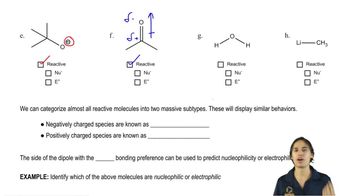
Reactivity of Molecules

Nucleophilic Substitution Reactions

Nucleophilic substitution reactions involve the replacement of a leaving group by a nucleophile. In the case of phosgene reacting with propylamine, the amine acts as a nucleophile, attacking the carbonyl carbon and displacing a chlorine atom. This concept is essential for determining the structure of the product formed when phosgene reacts with amines.
Recommended video:
Guided course
01:47
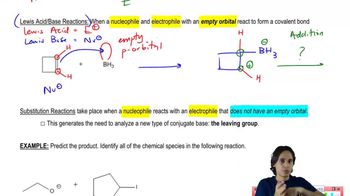
Nucleophiles and Electrophiles can react in Substitution Reactions.

Hydrolysis of Carbonyl Compounds

Hydrolysis is the reaction of a compound with water, leading to the breakdown of that compound. When phosgene reacts with excess water, it undergoes hydrolysis to form carbonic acid and hydrochloric acid. This process is important for understanding how phosgene can be neutralized in the presence of water and the resulting products of such a reaction.
Recommended video:
Guided course
01:40
Defining meso compounds.