Textbook Question
a. When a carboxylic acid is dissolved in isotopically labeled water (H2O18) and an acid catalyst is added, the label is incorporated into both oxygens of the acid. Propose a mechanism to account for this.
2
views

 Bruice 8th EditionCh. 15 - Reactions of Carboxylic Acids and Carboxylic Acid DerivativesProblem 74a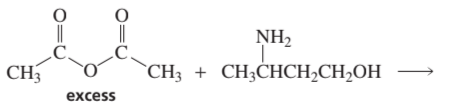
 Verified step by step guidance
 01:47
01:47
 03:50
03:50 02:16
02:16a. When a carboxylic acid is dissolved in isotopically labeled water (H2O18) and an acid catalyst is added, the label is incorporated into both oxygens of the acid. Propose a mechanism to account for this.
An aqueous solution of a primary or secondary amine reacts with an acyl chloride to form an amide as the major product. However, if the amine is tertiary, an amide is not formed. What product is formed? Explain.
Phosgene (COCl2) was used as a poison gas in World War I. What product would be formed from the reaction of phosgene with each of the following reagents?
c. excess propylamine
d. excess water
When a student treated butanedioic acid with thionyl chloride, she was surprised to find that the product she obtained was an anhydride rather than an acyl chloride. Propose a mechanism to explain why she obtained an anhydride.
a. When a carboxylic acid is dissolved in isotopically labeled water (H2O18) and an acid catalyst is added, the label is incorporated into both oxygens of the acid. Propose a mechanism to account for this.
c. If an ester is dissolved in isotopically labeled water (H2O18) and an acid catalyst is added, where will the label reside in the product?
When butanoic acid and 18O-labeled methanol react under acidic conditions, what compounds are labeled when the reaction has reached equilibrium?