Ch. 15 - Reactions of Carboxylic Acids and Carboxylic Acid Derivatives
Bruice - Organic Chemistry 8th Edition
Bruice8th EditionOrganic ChemistryISBN: 9780135213711Not the one you use?Change textbook
Chapter 16, Problem 71

When a student treated butanedioic acid with thionyl chloride, she was surprised to find that the product she obtained was an anhydride rather than an acyl chloride. Propose a mechanism to explain why she obtained an anhydride.

Verified step by step guidance
1
Identify the reactants and their roles: Butanedioic acid (a dicarboxylic acid) reacts with thionyl chloride (SOCl₂), which is commonly used to convert carboxylic acids into acyl chlorides. However, the presence of two carboxylic acid groups in butanedioic acid allows for additional reactivity.
Understand the initial reaction: Thionyl chloride reacts with one of the carboxylic acid groups in butanedioic acid. This reaction involves the nucleophilic attack of the carboxylic acid oxygen on the sulfur atom of SOCl₂, leading to the formation of an intermediate where the hydroxyl group is replaced by a chlorine atom, forming a monoacyl chloride.
Consider the proximity of the second carboxylic acid group: The second carboxylic acid group in butanedioic acid is in close proximity to the newly formed acyl chloride. This spatial arrangement allows for an intramolecular reaction to occur.
Propose the intramolecular reaction: The lone pair of electrons on the oxygen atom of the second carboxylic acid group attacks the carbonyl carbon of the acyl chloride. This nucleophilic attack leads to the formation of a tetrahedral intermediate, which subsequently eliminates a molecule of HCl to form the cyclic anhydride.
Conclude the mechanism: The final product is a cyclic anhydride, specifically succinic anhydride, due to the intramolecular reaction facilitated by the proximity of the two carboxylic acid groups in butanedioic acid. This explains why the student observed an anhydride instead of an acyl chloride as the product.

Verified video answer for a similar problem:

This video solution was recommended by our tutors as helpful for the problem above.
Video duration:
8m
Was this helpful?

Key Concepts

Here are the essential concepts you must grasp in order to answer the question correctly.

Butanedioic Acid Structure

Butanedioic acid, also known as succinic acid, is a dicarboxylic acid with two carboxyl (-COOH) groups. Its structure allows for the possibility of intramolecular reactions, which can lead to the formation of an anhydride. Understanding the molecular structure is crucial for predicting how it reacts with reagents like thionyl chloride.
Recommended video:
1:05
Citric Acid Cycle Structures Concept 1

Thionyl Chloride as a Reagent

Thionyl chloride (SOCl2) is commonly used to convert carboxylic acids into acyl chlorides. However, it can also facilitate the formation of anhydrides through a dehydration mechanism. Recognizing the dual role of thionyl chloride helps explain the unexpected formation of an anhydride instead of the anticipated acyl chloride.
Recommended video:
Guided course
01:36
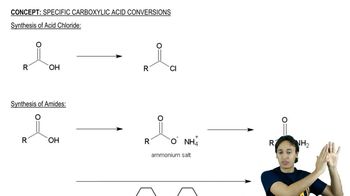
Synthesis of Acid Chlorides

Anhydride Formation Mechanism

The formation of an anhydride from butanedioic acid involves a dehydration reaction where two carboxylic acid molecules lose a water molecule. This process can be catalyzed by thionyl chloride, which promotes the removal of water and allows the carboxyl groups to react with each other, leading to the formation of the anhydride. Understanding this mechanism is key to explaining the student's observation.
Recommended video:
Guided course
03:35
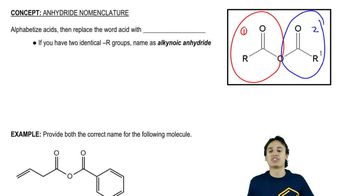
Anhydride Nomenclature