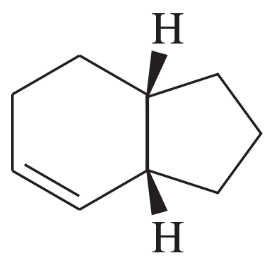
Draw a three-dimensional structure for each compound, and star all asymmetric carbon atoms. Draw the mirror for each structure, and state whether you have drawn a pair of enantiomers or just the same molecule twice. Build molecular models of any of these examples that seem difficult to you. (i)
Verified step by step guidance
1
Analyze the given structure: The compound is a bicyclic molecule with two hydrogen atoms attached to a bridgehead carbon. The structure includes a double bond in one of the rings.
Identify asymmetric carbon atoms: Look for carbon atoms that are bonded to four different groups. In this case, the bridgehead carbon atoms are asymmetric because they are connected to distinct groups (hydrogen, two different ring systems, and the double bond). Star these asymmetric carbons in your drawing.
Draw the mirror image: To create the mirror image, invert the spatial arrangement of the groups around the asymmetric carbons. Ensure that the hydrogen atoms and the rings are flipped appropriately to reflect the mirror image.
Determine the relationship between the original structure and its mirror image: Compare the two structures. If they are non-superimposable mirror images, they are enantiomers. If they are superimposable, they represent the same molecule.
Build molecular models if needed: Use molecular modeling kits or software to visualize the three-dimensional arrangement of the atoms. This can help confirm the spatial relationships and the identification of enantiomers.
Verified video answer for a similar problem:
This video solution was recommended by our tutors as helpful for the problem above
Video duration:
2m
Play a video:
0 Comments
Key Concepts
Here are the essential concepts you must grasp in order to answer the question correctly.
Asymmetric Carbon Atoms
Asymmetric carbon atoms, or chiral centers, are carbon atoms bonded to four different substituents, leading to non-superimposable mirror images. These centers are crucial in determining the stereochemistry of a molecule, as they give rise to different spatial arrangements, known as stereoisomers. Identifying these atoms is essential for understanding the three-dimensional structure of organic compounds.
The difference between atomic numbers and atomic mass.
Enantiomers
Enantiomers are a type of stereoisomer that are mirror images of each other but cannot be superimposed. They typically arise from molecules with one or more asymmetric carbon atoms. Enantiomers have identical physical properties in a symmetrical environment but can exhibit different behaviors in chiral environments, such as biological systems, making their distinction important in organic chemistry.
How to solve for the percentage of each enantiomer.
Molecular Models
Molecular models are physical or digital representations of molecules that help visualize their three-dimensional structures. These models can illustrate the spatial arrangement of atoms, bond angles, and the presence of chiral centers. Building molecular models is a valuable tool for understanding complex organic compounds, especially when dealing with stereochemistry and enantiomeric relationships.