
Ch.5 - Stereochemistry
Wade - Organic Chemistry 9th Edition
Wade9th EditionOrganic ChemistryISBN: 9780135213728Not the one you use?Change textbook
Chapter 5, Problem 36d,e,f

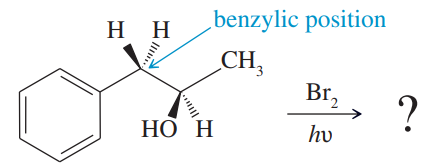
Free-radical bromination of the following compound introduces bromine primarily at the benzylic position next to the aromatic ring. If the reaction stops at the monobromination stage, two stereoisomers result.
Chemical structure showing a compound with a benzylic position, indicating bromination and potential stereoisomer formation.
d. What is the relationship between the two isomeric products?
e. Will these two products be produced in identical amounts? That is, will the product mixture be exactly 50:50?
f. Will these two stereoisomers have identical physical properties such as boiling point, melting point, solubility, etc.? Could they be separated (theoretically, at least) by distillation or recrystallization?

Verified step by step guidance
1
Step 1: Analyze the reaction conditions. The reaction involves free-radical bromination using Br₂ and hv (light). This type of reaction typically occurs at the most stable radical position, which in this case is the benzylic position adjacent to the aromatic ring.
Step 2: Consider the stereochemistry of the benzylic position. The benzylic carbon is a stereocenter, meaning that bromination at this position can lead to two stereoisomers due to the formation of a new chiral center.
Step 3: Address part (d). The relationship between the two isomeric products is that they are enantiomers. Enantiomers are non-superimposable mirror images of each other, differing in the spatial arrangement of atoms around the chiral center.
Step 4: Address part (e). The two enantiomers will be produced in identical amounts (50:50) because the reaction does not favor one enantiomer over the other. This is due to the symmetrical nature of the radical intermediate formed during the reaction.
Step 5: Address part (f). Enantiomers have identical physical properties such as boiling point, melting point, and solubility in achiral environments. However, they can be separated theoretically by methods such as recrystallization using a chiral resolving agent or chromatography on a chiral stationary phase, but not by simple distillation.

Verified video answer for a similar problem:

This video solution was recommended by our tutors as helpful for the problem above.
Video duration:
3m
Was this helpful?

Key Concepts

Here are the essential concepts you must grasp in order to answer the question correctly.

Free-Radical Bromination

Free-radical bromination is a reaction mechanism where bromine (Br2) reacts with alkanes or substituted alkanes in the presence of light or heat, generating bromine radicals. These radicals abstract hydrogen atoms from the substrate, leading to the formation of alkyl radicals, which can then react with bromine to form bromoalkanes. This process is selective, often favoring the formation of products at more stable radical sites, such as benzylic positions adjacent to aromatic rings.
Recommended video:
Guided course
05:20
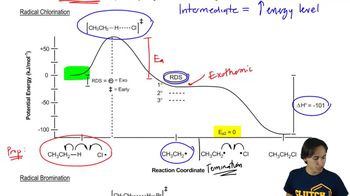
Using the Hammond Postulate to describe radical bromination.

Stereoisomers

Stereoisomers are compounds that have the same molecular formula and connectivity of atoms but differ in the spatial arrangement of their atoms. In the context of bromination at the benzylic position, two stereoisomers can arise due to the presence of chiral centers created during the reaction. These isomers can exhibit different physical properties and reactivity, making their study important in organic chemistry.
Recommended video:
Guided course
01:58
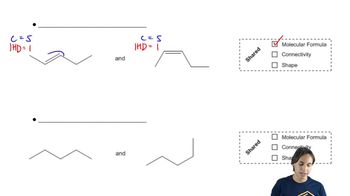
Determining when molecules are stereoisomers.

Physical Properties of Stereoisomers

Stereoisomers can have different physical properties, such as boiling points, melting points, and solubility, due to their distinct spatial arrangements. For example, enantiomers (a type of stereoisomer) often have identical physical properties in achiral environments but can behave differently in chiral environments. This difference can affect separation techniques like distillation or recrystallization, where the isomers may not be produced in equal amounts, leading to potential challenges in isolating them.
Recommended video:
0:53
Physical Properties of Fatty Acids Concept 1
Related Practice
Textbook Question

3,4-Dimethylpent-1-ene has the formula CH2=CH—CH(CH3)—CH(CH3)2. When pure (R)-3,4-dimethylpent-1-ene is treated with hydrogen over a platinum catalyst, the product is (S)-2,3-dimethylpentane.

a. Draw the equation for this reaction. Show the stereochemistry of the reactant and the product.

b. Has the chiral center retained its configuration during this hydrogenation, or has it been inverted?

Textbook Question

The specific rotation of (S)-2-iodobutane is +15.90°.

a. Draw the structure of (S)-2-iodobutane.

b. Predict the specific rotation of (R)-2-iodobutane.

c. Determine the percentage composition of a mixture of (R)- and (S)-2-iodobutane with a specific rotation of –7.95°.

1
views
Textbook Question

3,4-Dimethylpent-1-ene has the formula CH2=CH—CH(CH3)—CH(CH3)2. When pure (R)-3,4-dimethylpent-1-ene is treated with hydrogen over a platinum catalyst, the product is (S)-2,3-dimethylpentane.

d. How useful is the (R) or (S) designation for predicting the sign of an optical rotation? Can you predict the sign of the rotation of the reactant? Of the product? (Hint from Juliet Capulet: “What’s in a name? That which we call a rose/By any other name would smell as sweet.”)

2
views
Textbook Question

For each structure,

1. draw all the stereoisomers.

2. label each structure as chiral or achiral.

3. give the relationships between the stereoisomers (enantiomers, diastereomers).

(a)

Textbook Question

3,4-Dimethylpent-1-ene has the formula CH2=CH—CH(CH3)—CH(CH3)2. When pure (R)-3,4-dimethylpent-1-ene is treated with hydrogen over a platinum catalyst, the product is (S)-2,3-dimethylpentane.

c. The reactant is named (R), but the product is named (S). Does this name change imply a change in the spatial arrangement of the groups around the chiral center? So why does the name switch from (R) to (S)?

1
views
Textbook Question

Free-radical bromination of the following compound introduces bromine primarily at the benzylic position next to the aromatic ring. If the reaction stops at the monobromination stage, two stereoisomers result.

a. Propose a mechanism to show why free-radical halogenation occurs almost exclusively at the benzylic position.

b. Draw the two stereoisomers that result from monobromination at the benzylic position.

c. Assign R and S configurations to the asymmetric carbon atoms in the products.

1
views