Ch.5 - Stereochemistry
Wade - Organic Chemistry 9th Edition
Wade9th EditionOrganic ChemistryISBN: 9780135213728Not the one you use?Change textbook
Chapter 5, Problem 34

The specific rotation of (S)-2-iodobutane is +15.90°.
a. Draw the structure of (S)-2-iodobutane.
b. Predict the specific rotation of (R)-2-iodobutane.
c. Determine the percentage composition of a mixture of (R)- and (S)-2-iodobutane with a specific rotation of –7.95°.

Verified step by step guidance
1
Step 1: (a) To draw the structure of (S)-2-iodobutane, start by identifying the chiral center. In 2-iodobutane, the chiral center is the second carbon atom. Assign the substituents: an iodine atom (I), a methyl group (CH₃), an ethyl group (CH₂CH₃), and a hydrogen atom (H). Arrange these substituents around the chiral center in a tetrahedral geometry. Use the Cahn-Ingold-Prelog (CIP) priority rules to assign priorities: I > CH₂CH₃ > CH₃ > H. Ensure the lowest priority group (H) is positioned away from the viewer, and arrange the remaining groups in a counterclockwise direction to represent the (S)-configuration.
Step 2: (b) The specific rotation of an enantiomer is equal in magnitude but opposite in sign to its mirror image. Since the specific rotation of (S)-2-iodobutane is +15.90°, the specific rotation of (R)-2-iodobutane will be -15.90°. This is because enantiomers rotate plane-polarized light in opposite directions but to the same degree.
Step 3: (c) To determine the percentage composition of a mixture of (R)- and (S)-2-iodobutane with a specific rotation of -7.95°, use the formula for the observed specific rotation: \( \text{[α]}_{\text{obs}} = \text{[α]}_{\text{pure}} \times (\% \text{R} - \% \text{S}) \). Here, \( \text{[α]}_{\text{obs}} = -7.95° \), \( \text{[α]}_{\text{pure}} = +15.90° \), and \( \% \text{R} + \% \text{S} = 100 \). Substitute the values into the formula and solve for \( \% \text{R} \) and \( \% \text{S} \).
Step 4: Rearrange the formula to express \( \% \text{R} - \% \text{S} \) in terms of the observed and pure specific rotations: \( \% \text{R} - \% \text{S} = \frac{\text{[α]}_{\text{obs}}}{\text{[α]}_{\text{pure}}} \). Substitute \( \text{[α]}_{\text{obs}} = -7.95° \) and \( \text{[α]}_{\text{pure}} = +15.90° \) to calculate \( \% \text{R} - \% \text{S} \).
Step 5: Use the two equations \( \% \text{R} + \% \text{S} = 100 \) and \( \% \text{R} - \% \text{S} = \frac{-7.95}{15.90} \) to solve for \( \% \text{R} \) and \( \% \text{S} \). Add and subtract the equations to isolate \( \% \text{R} \) and \( \% \text{S} \), which represent the percentage composition of the mixture.

Verified video answer for a similar problem:

This video solution was recommended by our tutors as helpful for the problem above.
Video duration:
5m
Was this helpful?

Key Concepts

Here are the essential concepts you must grasp in order to answer the question correctly.

Chirality and Stereoisomers

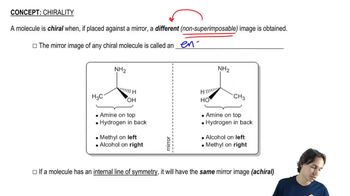
Chirality refers to the property of a molecule that makes it non-superimposable on its mirror image, leading to the existence of stereoisomers. In organic chemistry, chiral molecules often have two enantiomers, which are mirror images of each other, such as (S)- and (R)-2-iodobutane. Understanding chirality is essential for predicting the behavior of these compounds in optical activity and their interactions in biological systems.
Recommended video:
Guided course
05:10
What is chirality?

Specific Rotation

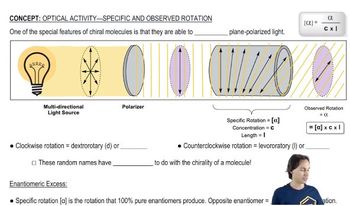
Specific rotation is a measure of how much a chiral compound rotates plane-polarized light, expressed in degrees. It is defined as the observed rotation of light divided by the product of the path length and the concentration of the solution. The specific rotation can vary between enantiomers, and knowing the specific rotation of one enantiomer allows for predictions about the other, as they will have equal magnitudes but opposite signs.
Recommended video:
Guided course
05:43
Specific rotation vs. observed rotation.

Enantiomeric Excess and Mixture Composition

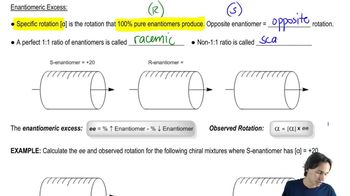
Enantiomeric excess (ee) quantifies the purity of a chiral mixture, calculated as the difference in the amounts of the two enantiomers. In a mixture of (R)- and (S)-2-iodobutane, the specific rotation can be used to determine the composition of the mixture. By applying the formula for specific rotation and knowing the specific rotations of the pure enantiomers, one can calculate the percentage of each enantiomer in the mixture.
Recommended video:
Guided course
04:21
How to calculate enantiomeric excess.
Related Practice
Textbook Question

For each structure,

1. draw all the stereoisomers.

2. label each structure as chiral or achiral.

3. give the relationships between the stereoisomers (enantiomers, diastereomers).

(a)

Textbook Question

Calculate the specific rotations of the following samples taken at 25 °C using the sodium D line.

a. 1.00 g of sample is dissolved in 20.0 mL of ethanol. Then 5.00 mL of this solution is placed in a 20.0-cm polarimeter tube. The observed rotation is 1.25° counterclockwise.

2
views
Textbook Question

(+)-Tartaric acid has a specific rotation Of +12.0°. Calculate the specific rotation of a mixture of 68% (+)-tartaric acid and 32% (–)-tartaric acid.

1
views
Textbook Question

Calculate the specific rotations of the following samples taken at 25 °C using the sodium D line.

b. 0.050 g of sample is dissolved in 2.0 mL of ethanol, and this solution is placed in a 2.0-cm polarimeter tube. The observed rotation is clockwise 0.043°.

1
views
Textbook Question

Free-radical bromination of the following compound introduces bromine primarily at the benzylic position next to the aromatic ring. If the reaction stops at the monobromination stage, two stereoisomers result.

d. What is the relationship between the two isomeric products?

e. Will these two products be produced in identical amounts? That is, will the product mixture be exactly 50:50?

f. Will these two stereoisomers have identical physical properties such as boiling point, melting point, solubility, etc.? Could they be separated (theoretically, at least) by distillation or recrystallization?

1
views
Textbook Question

Free-radical bromination of the following compound introduces bromine primarily at the benzylic position next to the aromatic ring. If the reaction stops at the monobromination stage, two stereoisomers result.

a. Propose a mechanism to show why free-radical halogenation occurs almost exclusively at the benzylic position.

b. Draw the two stereoisomers that result from monobromination at the benzylic position.

c. Assign R and S configurations to the asymmetric carbon atoms in the products.

1
views