Ch.5 - Stereochemistry
Wade - Organic Chemistry 9th Edition
Wade9th EditionOrganic ChemistryISBN: 9780135213728Not the one you use?Change textbook
Chapter 5, Problem 32a

Calculate the specific rotations of the following samples taken at 25 °C using the sodium D line.
a. 1.00 g of sample is dissolved in 20.0 mL of ethanol. Then 5.00 mL of this solution is placed in a 20.0-cm polarimeter tube. The observed rotation is 1.25° counterclockwise.

Verified step by step guidance
1
Understand the formula for specific rotation: \( [\alpha] = \frac{\alpha_{\text{obs}}}{l \cdot c} \), where \( [\alpha] \) is the specific rotation, \( \alpha_{\text{obs}} \) is the observed rotation, \( l \) is the path length in decimeters, and \( c \) is the concentration in g/mL.
Convert the path length \( l \) from cm to dm. Since 1 dm = 10 cm, divide the given path length (20.0 cm) by 10 to get \( l \) in dm.
Calculate the concentration \( c \) of the solution. First, determine the amount of sample in the 5.00 mL solution. Since 1.00 g of sample is dissolved in 20.0 mL of ethanol, the concentration of the stock solution is \( \frac{1.00}{20.0} \) g/mL. Multiply this by the volume of the solution used (5.00 mL) to find the mass of the sample in the polarimeter tube. Then divide this mass by the total volume of the solution in the polarimeter tube (5.00 mL) to get \( c \).
Substitute the observed rotation \( \alpha_{\text{obs}} = -1.25^{\circ} \) (negative because it is counterclockwise), the calculated path length \( l \), and the calculated concentration \( c \) into the specific rotation formula.
Simplify the expression to find the specific rotation \( [\alpha] \). Ensure the units are consistent and the final value is expressed with the correct sign and units (degrees·mL·g⁻¹·dm⁻¹).

Verified video answer for a similar problem:

This video solution was recommended by our tutors as helpful for the problem above.
Video duration:
3m
Was this helpful?

Key Concepts

Here are the essential concepts you must grasp in order to answer the question correctly.

Specific Rotation

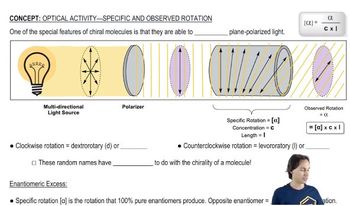
Specific rotation is a property of chiral compounds that quantifies their ability to rotate plane-polarized light. It is defined as the observed rotation of light (in degrees) divided by the path length of the sample (in decimeters) and the concentration of the solution (in grams per milliliter). This value is temperature and wavelength dependent, typically measured at 20 °C using the sodium D line (589 nm).
Recommended video:
Guided course
05:43
Specific rotation vs. observed rotation.

Polarimetry

Polarimetry is an analytical technique used to measure the optical activity of chiral substances. A polarimeter consists of a light source, a sample holder, and a detector. When plane-polarized light passes through a sample, the rotation of the light is measured, allowing for the determination of the specific rotation of the compound. This technique is crucial for characterizing enantiomers and assessing purity.

Concentration and Dilution

Concentration refers to the amount of solute present in a given volume of solution, typically expressed in grams per milliliter (g/mL). In the context of the question, a specific volume of a diluted solution is used to measure optical rotation. Understanding how to calculate concentration from mass and volume, as well as how dilution affects concentration, is essential for accurately determining specific rotation in polarimetry.
Recommended video:
2:36
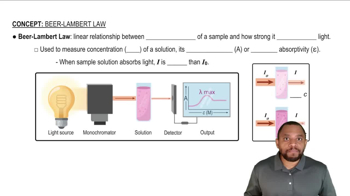
The Beer-Lambert Law Concept 1