Ch. 17 - Reactions of Aromatic Compounds
Wade - Organic Chemistry 9th Edition
Wade9th EditionOrganic ChemistryISBN: 9780135213728Not the one you use?Change textbook
Chapter 17, Problem 28

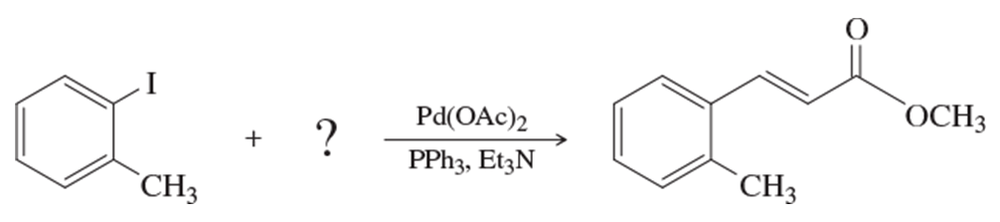
What substituted alkene would you use in the Heck reaction to make the following products?
(a)
(b)

Verified step by step guidance
1
Step 1: Understand the Heck reaction mechanism. The Heck reaction involves the coupling of an aryl or vinyl halide with an alkene in the presence of a palladium catalyst, leading to the formation of a substituted alkene.
Step 2: Analyze the product in part (a). The product contains a substituted alkene with a carboxylic acid group. This suggests that the alkene used in the reaction must have a carboxylic acid group attached to it.
Step 3: Determine the substituted alkene for part (a). To form the product shown, the alkene must be acrylic acid (CH₂=CH-COOH), as it provides the carboxylic acid functionality and the double bond required for the Heck reaction.
Step 4: Analyze the product in part (b). The product contains a biphenyl structure with a substituted alkene. This suggests that the alkene used in the reaction must have a phenyl group attached to it.
Step 5: Determine the substituted alkene for part (b). To form the product shown, the alkene must be styrene (CH₂=CH-Ph), as it provides the phenyl group and the double bond required for the Heck reaction.

Verified video answer for a similar problem:

This video solution was recommended by our tutors as helpful for the problem above.
Video duration:
4m
Was this helpful?

Key Concepts

Here are the essential concepts you must grasp in order to answer the question correctly.

Heck Reaction

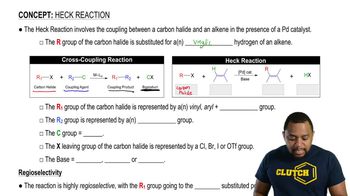
The Heck reaction is a palladium-catalyzed coupling reaction between an aryl or vinyl halide and an alkene, resulting in the formation of substituted alkenes. This reaction is significant in organic synthesis for constructing complex molecules and is widely used in the pharmaceutical and materials industries. The choice of alkene is crucial as it determines the structure of the final product.
Recommended video:
Guided course
05:09
Heck Reaction

Alkene Substitution

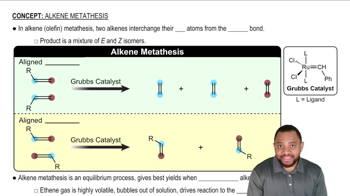
In the context of the Heck reaction, alkene substitution refers to the selection of an appropriate alkene that will react with the aryl halide to yield the desired product. The structure of the alkene, including its substitution pattern and stereochemistry, influences the regioselectivity and stereoselectivity of the reaction, which are essential for achieving the target compound.
Recommended video:
2:09
Alkene Metathesis Concept 1

Palladium Catalysis

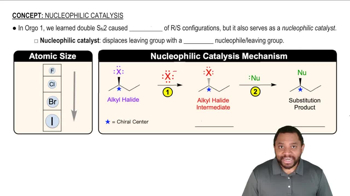
Palladium catalysis is a key component of the Heck reaction, where palladium complexes facilitate the formation of carbon-carbon bonds. The palladium catalyst, often in the form of Pd(OAc)2, activates the halide and alkene, allowing for the coupling to occur. Understanding the role of the catalyst and the reaction conditions is vital for optimizing yields and selectivity in synthetic applications.
Recommended video:
2:31
Nucleophilic Catalysis Concept 1